

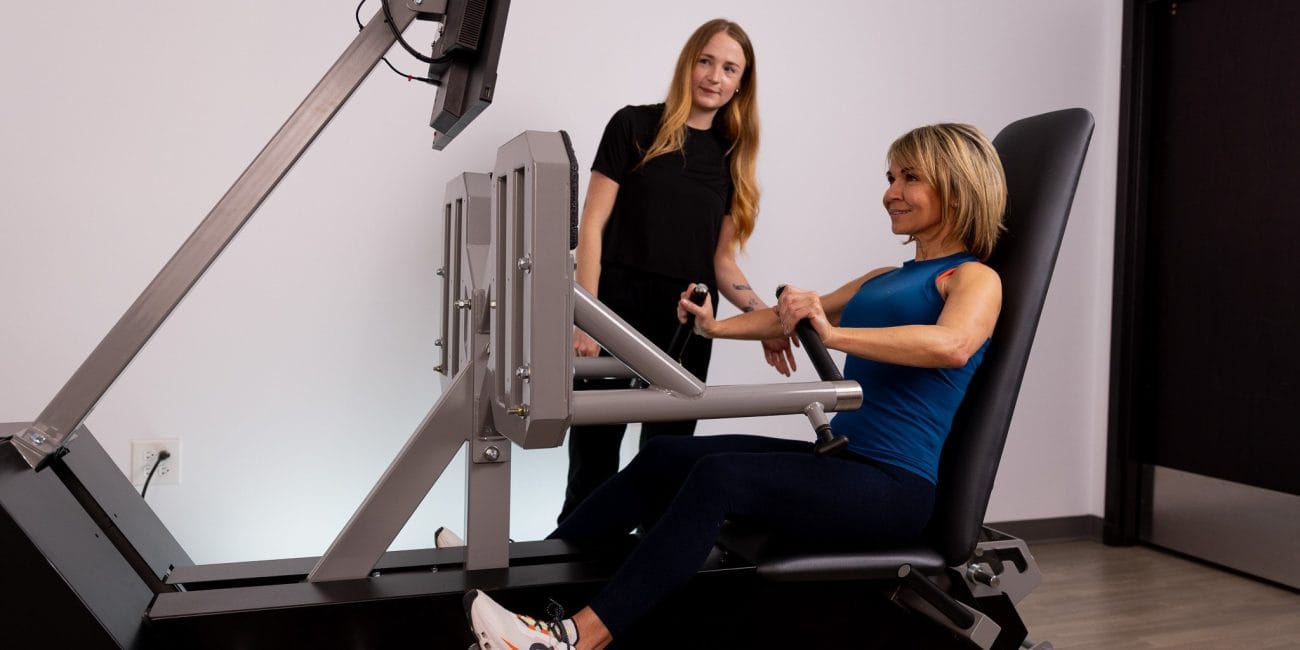
The idea has been around forever, but there’s been a recent increase in the promotion and amplification of exercise modalities that take advantage of something known as “variable resistance.”
The old Nautilus cams (c. 1970), the coiled spring mechanisms before that (c. 1920s), the elastic resistance bands (c. 1895), and even Dr. Gustav Zander’s mechanotherapy devices (c. 1860) have all been used as an improvement over static, non-variable forms of resistance that work through gravity.
The principle here is that our strength changes during exercise. Sometimes we’re stronger, sometimes we’re weaker. This happens through mechanical advantage/disadvantage, through fatigue of the target muscles, or through the transition from concentric to eccentric muscle contraction.
Each example of variable resistance is an attempt to accommodate the user’s changing level of strength to more closely match the user to the tool being used.
Were these forms of resistance useful? Does variable resistance have a place in the modern exercise regimen?
For a quick primer, consider the following research on variable resistance and its benefits:
- In a meta-analysis by Schoenfeld, “a trend was noted for the superiority of heavy loading” with respect of muscle strength and hypertrophy
- The nervous system is actually less able to recruit contractile muscle fibers in the mechanically-weak ranges of motion in compound movements, the “sticking “points”
- Neural inhibition in the weak parts of the range of motion are evolutionary mechanisms to protect joints when the muscle is in a compromised position — study 1 & study 2
- After seven weeks of training, a group using variable resistance recorded significantly greater strength gains than a group using weights
- In a group of D1 football players, the group using variable resistance showed greater improvements in strength than the ones working out with conventional weights
- A group using variable resistance showed bigger increases in their velocity, power, and one-rep max on bench press than the weight-only group
- The greater the variation in resistance, the greater the muscle engagement during squats.
- The greater the variation in resistance, the greater the muscle engagement during deadlifts
- Participants doing variable resistance bench pressing had less shoulder stress, allowing them to train harder and continue to gain muscle and strength faster than the barbell bench group due to lack of neural inhibition and reduced risk of joint injury
- 10 weeks analysis showed banded resistance training resulted in a 21.5% performance increase compared with the control group
- Rugby players had greater improvements in explosive pushing power when using variable resistance
- The variable resistance group “elicited greater reflex adaptations compared to dynamic constant external resistance,” or weights, in other words
- Variable resistance was able to activate more muscle and positively influence jump performance after just one intervention, while standard weight training control group did not demonstrate any influence
- Squatting with variable resistance facilitates more weight used and time under muscle tension
- Variable resistance can be very useful for improving the training results of bodybuilders, powerlifters, and athletes
- Variable resistance loading of the strong range of motion leads to drastically increased muscle engagement
Well okay then, variable resistance may have a place in one’s training regimen!
So how does FastFit’s responsive resistance measure up in comparison to other tools that vary the resistance against which the user is made to contract? Read on…
The Mismatch Problem
The main principle of resistance exercise is that the target muscles are made to contract against a resistance for the purpose of delivering a stimulus to which the muscles must adapt over time.
Any time there is a difference between the strength of the muscles and the magnitude of the resistance against which the muscles are made to contract, we can say that a mismatch has been created between the two.
If the chosen resistance is below the momentary strength capacity of the muscles, this represents an inefficiency. More sets, more reps, and an overall greater time commitment are required to accumulate the desired workout volume because the mismatch has underloaded the target muscles.
Conversely, if the chosen resistance is above the momentary strength capacity of the muscles, this represents a serious risk of injury. An injury is produced when the body encounters a level of force that exceeds its capacity to absorb force.
This excessive force happens either through the inappropriate selection of resistance in the first place, or through the application of dangerous magnitudes of force as the user becomes fatigued and the formerly appropriate weight becomes excessive.
Whether it’s too little or too much, a mismatch between the level of resistance being applied to the muscles and the momentary strength of those muscles results in either an inefficient or dangerous exercise scenario, and often both within the same set of exercise!
The Workarounds
Imagine you want to go do some strength training, and you decide you’re going to use weights for this purpose because you either don’t know any better, or weights are the only tool available to you.
How do you get a good workout without excessive inefficiency or risk of injury?
Well, weight-lifting enthusiasts have developed some workarounds intuitively, even though they might not be able to articulate why they are making these sacrifices. They include — but are not limited to — things like:
- Workaround 1: Purposely using less than the maximum amount of weight than they can lift, typically designated as some percentage of their “one-rep max.” They need their set to last for some target number of repetitions, but a weight that matches their fresh strength—their one-rep max—would only permit one repetition, and at great personal risk of injury. Bummer.
- Workaround 2: The unavoidable underloading described above means they need to lift and lower the weight many, many times in order to accumulate the necessary workout volume. This undesirable necessity to perform so many sets per muscle group is turned from a “bug” into a “feature,” as they retroactively identify the undesirable time suck as “high-volume workouts” that are actually desirable per se.
- Workaround 3: The advanced lifters will even acknowledge the mismatch problem, correctly identifying that, for example, they’re stronger on the way down than on the way up. They can lower more than they can lift, in other words. So they’ll load up more weight than they can lift, have their buddies help lift it into place, then lower the weight by themselves to more closely match the amount of resistance to their momentary strength capacity. This yields improved results.
Baby Steps: The Variable Resistance Solutions
If only there were some way to more closely match the chosen resistance to the momentary strength capacity of the target muscles…wait a minute, we can do that!
Smarter men than I have devised brilliant ways of doing this. They all center around the basic premise that our strength capacity changes moment-by-moment as our joint angles change and we move into and out of mechanical advantage.
That is, we’re stronger at the top of a bench press with straight arms than we are at the bottom with the bar at our chest.
We’re stronger at the top of a barbell squat than we are at the bottom.
We’re stronger in the middle of a bicep curl than we are at either end of the range, we’re stronger in the mid-range of a compound row than we are at either end of the range, we’re stronger at the top of a shoulder press than we are at the bottom…you get the idea.
So we’re underloaded in the strong ranges and we’re overloaded in the weak ranges. This creates a scenario where weights underload the muscles and overload the joints.
Got it?
Variable Resistance to the rescue!
Elastic Resistance
Back in 1895 a guy in Switzerland named Gustav Gossweiler received a patent for a stretchy, handled rope-type thing that provided elastic resistance in the same way that modern elastic bands do.
As the band is stretched, the resistance increases. In movements like the chest press and the squat, for example, this means that the user is loaded with greater resistance as the repetition moves into mechanical advantage and lesser resistance when the repetition moves out of mechanical advantage, allowing for greater mechanical loading and greater set duration at the same time.
In the bicep curl, as another example, the resistance increases in magnitude as the user moves into a more contracted position:

In modern times, people use elastic bands on their barbells to either vary the resistance in addition to the weights they’re using, or simply connect the bands directly to the barbells for this purpose. Smart!
Arthur Jones’ Nautilus Cams / Gustav Zander’s Mechanotherapy
These two geniuses independently developed variable-resistance exercise equipment about one hundred years and half a world apart from each other.
Their devices work by lifting a weight stack using a cable that is wrapped around a pulley, just like at the gym. Except this is a special pulley called a cam. And it turns out that the larger the radius of the cam—the distance from the axis to the cable—the greater the multiplication of the resistance at the end of the cable—the weight stack.
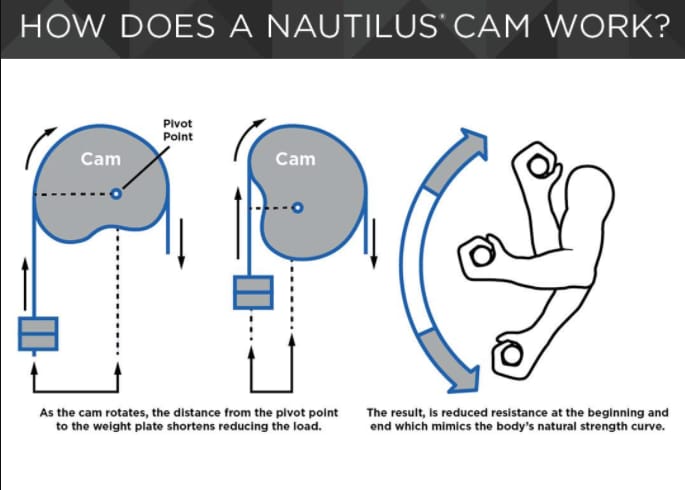
This gives the user more resistance at the points of mechanical advantage and greater leverage, and less resistance at the points of lesser mechanical advantage. Smart!
Honorable Mentions
- Chains attached to barbells that gather on the floor when the weight is lowered to reduce the resistance during weaker ranges of motion, then add to the resistance when pulled up off the floor as the user moves the barbell into the stronger ranges of motion.

- Pneumatic/hydraulic resistance that provides air pressure in direct proportion to the pushing — concentric — force production of the user. Only an honorable mention because, unfortunately, pneumatic resistance does not provide any meaningful resistance in the very-important eccentric phase of contraction.

Close, But No Cigar
What wasn’t taken into account by the forms of variable resistance is the fact that there is another, more important way that our strength changes during the course of a set of exercise aside from the change in strength due to mechanically-advantaged joint angles.
And that is, our strength changes drastically between concentric—“lifting”—and eccentric—“lowering”—phases of muscle contraction.
But cams, elastics, and other forms of variable resistance give you the same level of resistance in the eccentric as they give you in the concentric, just in the reverse pattern as the elastic returns to its original tension or the cam unwinds to its smaller radius.
This is a huge bummer since there are massive benefits to properly-loaded eccentric contractions!
There have been several notable attempts to add an “eccentric overload” component to a device’s resistance profile.
Quick pedantic note about why “eccentric overload” is in scare quotes: if you’re used to lifting weights—which give you the same resistance on the way up and on the way down—then having the experience of a properly-loaded eccentric contraction will feel like “overload” to you.
The truth is that a muscle, properly loaded with matched resistance, receives more in the eccentric because it can produce more in the eccentric.
So providing more resistance in the eccentric isn’t “overloading” the negative. It’s properly loading the negative.
Anyhow, the two “close but no cigar” innovations that come to mind that have attempted to address this concentric/eccentric mismatch are:
- Flywheel devices, which store the kinetic energy produced in the concentric phase, add a preselected multiplier, and then use the flywheel to redeploy the amplified resistance back at you during the eccentric phase.

- A tilting weight stack device that provides regular variable resistance using a cam on the concentric while the weight stack is tilted to the side, and then uses a small motor to actually tilt the weight stack to the full-force vertical position during the eccentric.
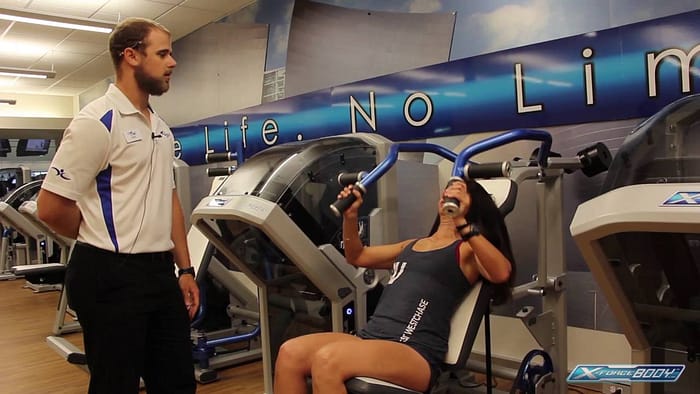
These are all very innovative for their time, and it’s obvious that a TON of ingenuity and effort has been invested into trying to match the resistance the user encounters with the strength capacity of the user during exercise.
But we’re still left with doubts and questions: is variable resistance that adds more resistance as you move into greater mechanical advantage AND gives you more resistance during the eccentric phase of muscle contraction the best-possible way to match the resistance to the user’s strength capacity?
Responsive Resistance Is King
Well, it turns out that not only do the variable and “eccentric overloading” forms of resistance fail to match the user’s strength capacity (they’re closer than weights, but never perfect), there is actually a third way that our strength changes during a set of exercise!
We are far stronger at the beginning of a set than we are at the end of a set.
This means that any form of resistance that claims to match the user’s strength to prevent the mismatch produced by traditional resistance exercise tools must include resistance that varies the resistance it provides between the beginning and the end of a set.
This brings us to a total of three ways that our strength capacity changes during a set of exercise:
- From joint angles of mechanical advantage to joint angles of mechanical disadvantage
- From eccentric to concentric muscle contractions
- From the beginning of the set to the end
If your resistance doesn’t account for each of these three factors, your resistance doesn’t match with the user’s strength capacity. And, as we’ve covered, this mismatch represents an inefficiency, an excessive risk of injury, or both.
FastFit technology accounts for each of these factors perfectly and automatically, every time no matter what, for every person regardless of age, limb lengths, training status, or any other variable.
Every joint angle you move through is perfectly loaded. As you move into and out of mechanical advantage, you are loaded in perfect proportion to your momentary strength capacity.
From the eccentric to the concentric, there is never a mismatch. There is never a point at which you could be producing more force but are not allowed to because the resistance is underloading you.
From the beginning of the set to the end of a set, you receive a level of resistance that is perfectly matched to your strength capacity. As much as your fresh muscles can handle at the beginning, you can have. As little as you require as you fatigue at the end of the set, our responsive resistance will accommodate you and provide the precise correct magnitude of resistance.
Any time your strength changes during a set, for any reason, FastFit matches you perfectly. This means you can never be underloaded (efficiency) and you can never be overloaded (safety). You are always perfectly loaded by a perfect form of pure resistance.
We have solved the mismatch problem inherent in every other resistance exercise tool.
We Like What You’re Trying To Do…
Every invention and technology we’ve mentioned has been a necessary step towards the eventual FastFit solution. These attempts at solving the mismatch problem were necessary to form the foundation from which we could build our technology.
“We stand on the shoulders of giants,” as Isaac Newton said.
We often point out that we’re “all on the same team” and all trying to help bring more effective, safer solutions to the public.
With all the previous points considered, the landscape here in 2021 now looks like this:
- Gravity-Based Resistances (weights, bodyweight, etc): apply static levels of resistance that do not change to accommodate the user’s varying strength at different joint angles, from concentric to eccentric, or from the beginning of a set to the end.
- Elastic Resistances: apply greater resistance at stronger joint angles, but not enough to match the user’s capacity—purposely underloaded, otherwise only one repetition would be possible. Also does not accommodate the user’s varying strength from concentric to eccentric or from the beginning of a set to the end.
- Nautilus Cams: apply greater resistance at stronger joint angles, but not enough to match the user’s capacity—otherwise only one repetition would be permitted. Also does not accommodate the user’s varying strength from concentric to eccentric or from the beginning of a set to the end.
- Flywheels: do not change to accommodate the user’s changing strength at stronger joint angles. Gives more eccentric resistance than concentric, but in a way that either underloads or overloads both phases of contraction since the eccentric : concentric ratio changes with every repetition and the flywheel resistance does not. Also does not accommodate the user’s varying strength from the beginning of a set to the end.
- Tilted Weight Stack Machines: apply greater resistance at stronger joint angles, but not enough to match the user’s capacity—purposely underloaded, otherwise only one repetition would be permitted. Gives more eccentric resistance than concentric, but in a way that either underloads or overloads both phases of contraction since the eccentric : concentric ratio changes with every repetition and the device’s resistance does not. Also does not accommodate the user’s varying strength from the beginning of a set to the end.
…But Our Way Is Best and It’s Not Close
- FastFit’s responsive resistance: applies perfectly-matched resistance that rises during the strong part of the range of motion and decreases during the weak part of the range of motion, never too much or too little. Perfectly accommodates the increased strength capacity of both eccentric contractions and concentric contractions. Matches the user’s strength pound-for-pound at all times, from the very first repetition the final repetition, without compromise.
An Idea Whose Time Has Come
There is simply no way around it.
The form of resistance that perfectly matches the user’s force-producing capacity must be the best way to deliver the resistance exercise stimulus.
Maximum efficiency.
Maximum effectiveness.
Maximum safety.
Pure, responsive resistance with zero limits.
If you’re not making use of variable resistance in your exercise regimen, you should be.
If you already are a fan of variable resistance in your exercise regimen, then the logical conclusion to your search for the highest-quality workout is FastFit.
–
Originally published by Jim Keen, Director of Education, on Medium.com


