


If It Ain’t Broke, Don’t Fix It?
Why would a trainer of athletes need to have FastFit in his arsenal?
What advantages can the use of FastFit offer above and beyond what’s available in million-dollar facilities all across the globe?
Well, consider the status quo in the Strength & Conditioning world right now:
- The athletes attempt to become more explosive and powerful by practicing ballistic movements, but the work is not as effective as it could be because of inconsistent muscular loading and misunderstandings around the relationships between strength, speed, power, and explosiveness.
- The nature of the ballistic, loaded movements — and the total time spent engaged in the training — produce not only acute injury during the training, but can often “set the stage” for an eventual injury during competition.
- The athletes spend 10+ hours per week on strength and conditioning, which represent hours that they are not watching film, working on skill practice with coaches, or engaging in other modalities like active recovery, mobility work, etc.
- There is a lack of measurement standards, and no way to granularly quantify the performance results in meaningful ways that can guide an athlete’s programming.
Huh. That’s actually not the rock-solid state of affairs that most people have assumed. How could these guys who get paid millions of dollars not have addressed these issues?
Is “if it ain’t broke, don’t fix it” a good attitude to have if you’re simply failing to notice that it is, in fact, “broke?”
The failure of the Strength & Conditioning world to innovate at the pace of the rest of our technological society is a topic for another day. We will just continue on with the solution we’ve built and let the chips fall where they may.
Why Even Have a Strength & Conditioning Program?
Why are we even doing all this in the first place?
Why don’t we just have the players practice on the field or court? What’s the deal with all the other “training” we’re doing?
Well there are two very good reasons that Strength & Conditioning is so important for athletes. The priorities for any Strength & Conditioning program are:
First Priority: Improve the athlete’s resistance to injury, without causing injury or degrading the athlete’s health in the process. I.e. “don’t hurt the athletes.”
DISTANT Second Priority: Increase the performance capacity of the athletes’ muscles and nervous systems. I.e. make the athletes “more athletic.”
At the highest levels of sport, the truth is that these folks are genetic royalty. Actual freaks in the technical sense of the term.
They’re going to be world-class athletes no matter what you do, and while their training can give them improvements in performance, the bigger priority is to simply ensure you don’t hurt them.
With those priorities in mind, what follows is a clear explanation of the four ways that FastFit matches and surpasses every other training tool available. They are:
- FastFit makes an athlete more explosive and powerful than is possible through the use of other training modalities
- FastFit carries a lower risk of injury while improving the athlete’s resistance to competition injury in the process
- FastFit requires a fraction of the time commitment relative to other training modalities, leaving more time for other coaching / skills practice
- FastFit quantifies more meaningful metrics of training performance more granularly than any other training modality
FastFit Makes Athletes More Explosive & Powerful
There is a lot of talk these days in athletic training circles about “explosiveness” and “power” as it pertains to athletes. Strength & Conditioning coaches swoon about an athletic prospect’s “motor” or his “get-there,” while sometimes not fully understanding what the causes and effects are in this context.
FastFit optimizes an athlete’s explosiveness in two primary ways.
First, by maximizing the athlete’s maximum strength — the magnitude of force the muscles can produce.
Second, by provoking the strongest-possible increase in fast-twitch muscle fiber expression over time.
A Stronger Athlete is a Faster Athlete
This first point is easily understood in the following example, adapted from this absolutely golden excerpt from a seminar given by Nautilus inventor Arthur Jones:
A young man comes into the gym and he’s never touched a weight in his life. And we put him in a leg press machine to test his strength.
Why a machine? Because we’re testing his strength, not his skill. Either he can raise it or he can’t. Either he can lift it or he can’t. He doesn’t have to balance it, he doesn’t have to have coordination or good technique, he doesn’t have to ‘hit the groove’…again, we don’t care about his skill, we want to test his strength.
And through testing, we find that he can lift 200lbs once in the leg press. Just barely. He gets it up there, but that’s all he can do. Not very fast, not very explosive.
So we rest him for ten minutes and then give him 210lbs. And he cannot move it. It’s too heavy.
Then we rest him for another ten minutes and give him 100lbs. We find that he can lift it, and his speed of movement is much faster than his speed during the 200lb lift. He — just like anyone else — is faster and more explosive with a weight that represents 50% of his one-repetition maximum than he is with a weight that is 100% of his one-repetition maximum.
Now it’s six months later, he’s been training regularly on FastFit equipment with maximally-loaded concentric and eccentric contractions — using a speed of motion that most would consider very slow — and we see that his max force production numbers are about twice what they were at first.
So we take him back into the gym, back to the same leg press machine, and we give him 400lbs. And he pushes it up. Not very fast, but it goes up.
He is twice as strong as he was six months earlier. Six months earlier he could only do it with 200lbs, now he can do it with 400lbs.
Are we now really dumb enough to believe that if we gave him the original 200lbs he would still only be able to move it with the explosiveness and power with which he moved it on the first day — that is, only very slowly?
Put your thinking cap on. At first, he was able to move 50% of his one-repetition maximum very quickly and powerfully. Six months later, is this not still true?
There are some who would have you believe that because he didn’t train at fast speeds during the six months in which we doubled his strength, he will now be unable to move any faster or more explosively when called upon to perform the same task as the initial strength test.
The obvious truth is that when your one-rep max is 200lbs you’ll be able to move 200lbs only very slowly.
If your one-rep max is 400lbs you’ll be able to move 200lbs very quickly and powerfully.
Same physical movement, but the athlete is much more explosive and powerful in the movement just because he’s stronger.
From Principle to Practice
So you can make an athlete more powerful and explosive merely by increasing their maximum level of strength, even if they have accomplished this increase in strength using very, very slow repetition speeds. Since slower repetition speeds are safer, all things being equal, this seems like a great deal.
Let’s see how this works outside the weight room.
Let’s say the athlete’s task — instead of the 200lb leg press — is to perform a sprint to first base, a forty-yard dash, a vertical leap, a golf swing, or a deceleration followed by a change in direction.
The amount of force needed to perform these movements stays largely the same over time unless the athlete has a huge change in body weight. So this force demand can represent the original 200lb leg press from our previous example.
If we train the involved musculature to increase the athlete’s force-producing capacity over time, you can see that the force demands in question — the athletic movements I listed above — occupy a smaller and smaller proportion of the athlete’s increasing strength.
And as we’ve seen, the smaller the proportion of an athlete’s force-producing capacity a given movement occupies, the more explosive the athlete can be in that movement.
It has nothing at all to do with the speed used during the training that increased the athlete’s strength.
It is entirely a result of the fact that the athlete is now stronger per se.
Power = Work / Time
If an athlete can perform more work in a given unit of time, we can say he is becoming more powerful. The athlete demonstrates this increasing power production by exhibiting more explosive movements during competition.
The development of explosive power, then, is simply increasing the amount of cumulative work that can be done within some time limit.
How do we best do that?
Work = Force x Distance
We can increase the amount of work an athlete can do by increasing the amount of force the athlete is able to deliver over some given distance.
In sports, the distances are often not subject to change:
- The distance between the defensive end and the quarterback will be the same year after year.
- The distance between home and first base will be the same year after year.
- The distance between the top of a backswing and the point of contact will be the same year after year.
- The distance between the half-court line to the baseline will be the same year after year.
- The distance between the top of a bicycle’s pedal stroke to the bottom will be the same year after year.
- The distance between the defensive backfield and the line of scrimmage will be the same year after year.
- The distance between the flexed-knee / flexed hip position and the extended-knee / extended hip position that propels you in your vertical leap will be the same year after year.
You get the idea.
So if we don’t have much influence on the Distance part of the Work equation, what does that leave us with?
That’s right. Force.
And force is produced by muscles.
And the force-producing capacity of the muscles is called strength.
So by increasing our strength, we increase the Force part of the Work equation.
And by increasing the Force part of the Work equation, we increase Work, which increases our Power.

The Elusive Obvious
So there you have it, in a way that one cannot possibly fail to understand, no matter how much one’s paycheck depends on one not understanding.
You do not need to “train fast” to improve your explosiveness or power. In fact, it could actually be counterproductive since adding ballistic momentum to your movements greatly increases your risk of injury.
Remember that you still do have to practice the explosive skills of your sport in order to maximize your explosive power in those movements.
You cannot perform resistance training exclusively and expect to be the most explosive athlete in your specific sport.
But out of all the athletes who have practiced to the same skill level in a given movement or phase of their competition, the advantage will go to the one who has developed the greatest strength level in their auxiliary Strength & Conditioning work.
A stronger athlete is a faster, more explosive athlete, and the responsive resistance available through the use of FastFit provides the greatest magnitudes of mechanical loading possible, which stimulates the most rapid and most potent increases in maximum levels of strength.
This is the primary reason that FastFit is the best tool available for increasing an athlete’s explosive power.
Build Your Fast-Twitch Fiber, Build Your Explosiveness
There is also, however, a secondary reason that FastFit is the best tool available for increasing an athlete’s explosive power.
It is well known in muscle physiology that muscle fibers are not merely differentiated into fast and slow twitch. There are Type I, Type IIa, and Type IIx, but a lot of people don’t understand that there are a lot of hybrid fibers in between.
Even then, it’s a bit of a misnomer that there are even distinct “types” of fibers, because the majority of muscle fibers can actually change characteristics as an adaptation to the specific demand placed on them.
That is, while there are some fibers that will always be slow-twitch (low force production and greater endurance) and some that will always be fast twitch (high force production and lesser endurance), there are mostly intermediate fibers that can “express” as different types based on the athlete’s training.
So is there a type of training that can preferentially recruit these “hybrid” intermediate fibers into the powerful, explosive fast-twitch fibers that can make an athlete faster and more explosive during competition?
It turns out there is.
When the athlete’s muscle fibers are made to contract with high magnitudes of force during training, the fibers can change their expression to be more fast-twitch over time.
What type of training involves the highest-possible force demand? As we can see from our strength curve data, it’s the eccentric phase of contraction (when an active muscle lengthens) that offers the greatest capacity for force production — if it’s properly loaded — and thus the greatest capacity to stimulate the differentiation of the intermediate fibers into a fast-twitch phenotype.
And what’s the best tool for safe, quantifiable, high-force eccentrics? That’s right, it’s FastFit. Properly-loaded eccentrics on FastFit — which are dangerous and impractical with traditional tools — preferentially recruit the fast-twitch fiber expression necessary for optimal athletic performance.
This study out of Germany, for example, showed a significant increase in muscle fiber cross-sectional area and jump height for concentric + eccentric training with eccentric “overload,” with benefits above and beyond traditional concentric-eccentric training.
Another interesting finding was an increased expression on mRNA for MHC IIX and glycolytic enzymes along with an increased cross-sectional area for type IIx — fast twitch/explosive — fibers.
What does this mean? It means that after the training period of the study, the muscles exposed to greater eccentric loading had transformed into faster, more explosively-powerful muscles! The study authors draw the conclusion that this type of training is good for explosive and fast sports.
Makes sense to us, not sure what the controversy is about ¯\_(ツ)_/¯
So that’s the second way FastFit optimizes an athlete’s power and explosiveness.
All things being equal, an athlete with more fast-twitch fiber is a faster, more powerful athlete, and the matched resistance available through the use of FastFit — especially during the safe, maximally-loaded eccentric contractions — provokes the most rapid and most potent increases in fast-twitch muscle fiber expression.
One Injury is Too Many
And now, the other—more important but less sexy—priority for any Strength & Conditioning program: resistance to injury.
There are two injury scenarios that an athlete must avoid. First is an injury suffered during the athlete’s training, and the second is an injury suffered during competition.
First off, if you are exercising for the purpose of increasing your health, an injury is unacceptable because injury is the exact opposite of health.
If you are training for the purpose of improving your athletic performance, an injury is unacceptable because injuries directly diminish your athletic performance.
Even worse for Strength & Conditioning professionals, an injury can cost the players and the team millions of dollars. Injuries are extremely expensive in terms of missed games, lower placements in the standings, and the downstream effects on all levels of the organization when a star player goes down.
This seems so basic as to not require mentioning, but even today many people—some of whom are very well-paid—think of injuries during training or exercise as “a necessary evil” or “just something you have to work around.”
But this is not true.
It is entirely possible — and highly desirable — to maximize your athletic capacity through resistance exercise without suffering injury in the short term and while increasing your resistance to injury in the long term.
So What Causes Injury In The First Place?
An injury occurs when a part of the body encounters a magnitude of force that exceeds that body part’s capacity to absorb force.
Typically this happens during a momentary peak in force, such as an impact, a landing, a rapid deceleration, or a rapid acceleration. Such a peak results in tears, strains, ruptures, pulls, and worse.
Seems simple enough, right? That’s what I thought, too. It reminds me of the old joke:
“Doc, it hurts when I do this.”
“Well uh…don’t do that.”

Makes sense to me.
But if it’s so simple to avoid injury, why are million-dollar athletes still suffering injuries during training and non-contact injuries during competition?
With the understanding that’s been laid out, one would guess that the first order of business to avoid injuries during training is to avoid excessive peak forces.
If you recall high school physics class, Force = Mass x Acceleration. So it would seem like the quickest way to reduce the injury rate would be to minimize acceleration and excessive speed.
But what do we see instead? Plyometrics, olympic weightlifting (even when the athlete is not a competitive weight lifter), explosive training for reps outside of sport-specific skill training, and a million variations of programs and protocols almost guaranteed to expose an athlete’s most at-risk joints to the very types of peak forces that must be avoided.
When you’re using weights or bodyweight or any gravity-based form of resistance, we can see how you’re sort of stuck here. You need high levels of mechanical loading so that there’s a potent strength adaptation (which we’ve seen increases explosiveness and power).
But the weights you’re using can only be so heavy, otherwise you can only lift them once, or not at all.
However, when you increase the weight being used (the “M” in F = MA), you increase the risk of injury in the process.
So in the interest of safety and accumulating sufficient volume, you have to compromise and reduce the weight you’re lifting, but that reduction then diminishes the strength improvement you’re getting.
So to increase the force demand on the athlete, you have to move faster and more explosively during training (the “A” in F = MA). But as we’ve seen, this increase in speed increases the odds that the athlete will encounter excessive peak forces.
Rock and a hard place.
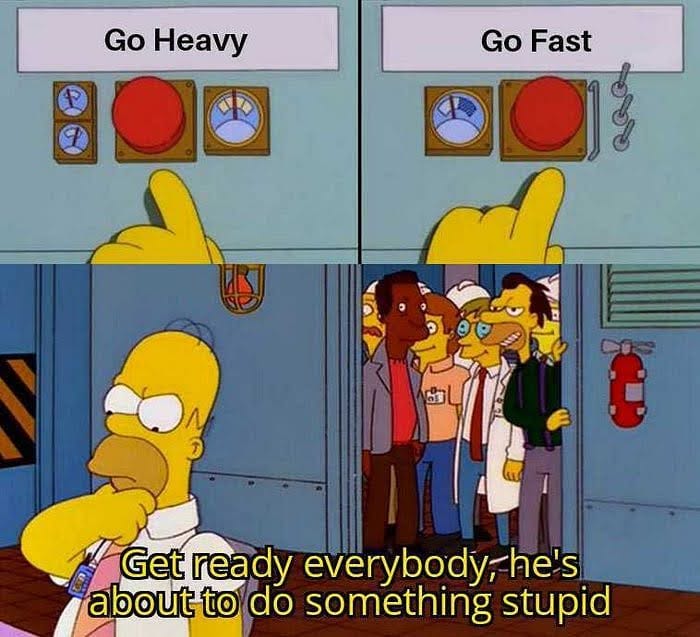
Your only two options to deliver a potent stimulus with traditional tools
Going heavier and going faster increase the effectiveness of the training, but increase the risk of injury in the process.
Reducing the weight and moving slower both reduce the risk of injury, but decrease the effectiveness of the training in the process.
And instead of acknowledging this limitation of the tools being used, Strength & Conditioning coaches reason backwards from their conclusions to convince their athletes — and themselves — that the unavoidably high levels of peak forces are a feature, not a bug!
“You gotta train fast to be fast.”
“Explosive training primes the nervous system to be explosive during competition.”
In essence, the situation has gone from the appropriate take of “The way we’re doing it has serious limitations, but it’s the best option we have because we’re limited by the tools we have available to us,” all the way to, “This approach does not have any limitation in terms of unnecessary injury risk, and it’s actually the best possible way to train these athletes since that’s the way we’re doing it.”
A Solution Emerges
Let’s apply our understanding from the first part of this article and see if we can question some faulty premises.
We know that becoming stronger and increasing fast-twitch fiber expression makes for a more explosive and powerful athlete. Can we do either of these while moving at a speed that will not produce excessive peak forces?
When you’re using weights it’s tough. Mechanical tension stimulates strength increase, and in order to move slowly the athlete will be forced to reduce the weight being used.
Mechanical tension is also required to place the necessary force demand on the muscle fibers to cause their differentiation into fast-twitch phenotypes.
So we’re stuck with low levels of weight in the interest of safety, which means our improvements in strength and in fast-twitch fiber expression will be limited.
FastFit completely solves this problem. A given muscle or group of muscles can be made to produce maximum-possible magnitudes of force — in both the concentric and eccentric phases — using FastFit’s matched responsive resistance.
There is no muscular capacity left unused during a maximal effort on an FastFit machine.
This means that mechanical loading is maximized. And that means that the strength stimulus and fast-twitch fiber expression is maximized.
And all at a slow, controlled speed of motion that would normally make such mechanical loading impossible.
So FastFit gives the athlete greater levels of mechanical tension than are possible with weights, at safer speeds than are possible with meaningful levels of weight-loaded resistance.
In the short term, the FastFit training completely avoids the excessive peak forces that could cause injury because the resistance responds to the user in real time.
This means that even though F still = MA, and FastFit maximizes the “M” in that equation (there are still “peaks”), they can never become excessive because the forces produced by the user can never be mismatched to the forces applied to the user by the machine in response.
So you don’t get any injuries during training.
In the long term, this mechanical loading enhances the athlete’s bone density and ligament/tendon thickness. The maximal eccentric contractions also provoke a greater capacity for that muscle to absorb force over time. So you get far fewer injuries during competition.

Why compromise?
No training injuries. Drastic reduction in competition injuries. While being more effective in the process.
Smart!
Ain’t Nobody Got Time for That
Another wild card here that often gets overlooked is time commitment. If you asked a Strength & Conditioning coach why the athletes are spending so much time each week in training, you’d probably get a response indicating that “it takes as long as it takes,” “that’s how much is required,” or the more honest, “this is the most efficient way we have available to us.”
With a big room full of weights and other traditional tools, this is mostly true.
Luckily, FastFit now exists. With FastFit’s responsive resistance, an athlete can provide the necessary stimulus to the muscles in a fraction of the time.
With a weight, you’re forced to under-load yourself (as we’ve discussed) to avoid injury, and so that your set can continue past one repetition. See this graph for example:

Those red peaks represent the force production in the eccentric phase. The black peaks represent the force production in the concentric phase. FastFit gives you both in perfect proportion every time, maximizing your force-producing capacity.
The horizontal line represents a weight, which is the same weight all the time and doesn’t maximize your capacity to produce force. That is, if you lift 225lbs, you have to lower 225lbs even if you could have lowered much, much more than that.
With this concentrated dose of the “active ingredient” in resistance exercise, it’s no wonder an athlete can accomplish the goals of training in such a small period of time. 10+ hours per week of Strength & Conditioning work can easily turn into one or two hours per week.
What could an athlete do with an extra eight hours per week? That’s thirty-two hours per month that can be spent analyzing game film, practicing drills and other sport-specific skills, or engaging in other useful training modalities (recovery tech, mobility, etc).
Imagine a whole team having that time freed up. And then imagine how those hours would compound month after month, year after year, and what type of competitive advantage would begin to build as your team got better training results than the competition, fewer injuries than the competition, and hundreds of additional hours of practice than the competition.
“In God We Trust. All Others Must Bring Data.”
Without quantification of results, an athlete’s Strength & Conditioning program is just a fun hobby.
When you are limited to counting reps, sets, and weight, there’s only so much you can learn from your data.
Sure you did one fewer repetition, but are you sure you were going at the same rep speed? How are you standardizing that?
Are you sure you remember your reps from the workout eighteen weeks ago? Your form, your range of motion? How are you standardizing that?
Are you positive you had the same duration of rest in between reps? How are you standardizing that?
If there’s no way to standardize all of this, your numbers are meaningless. Like GPS directions that are zoomed out to a full state view when you’re trying to get to a place in your town.
Some innovative people have developed very high-tech ways to quantify barbell work that take into account things like Rep Speed, Power, Velocity, Rate of Force Development, and other metrics. But this is akin to installing a speedometer and odometer on your horse.
New ways to measure the performance of old tech.
FastFit combines all of the above. Not only does FastFit provide a form of resistance that is superior to gravity-based resistance, FastFit also tracks Speed, Distance, Positioning Data (down to the hundredth of an inch), Momentary Force, Average Force, Cumulative Work, Reps, Time Under Tension, and other derivative measures like Rate of Force Development and Work Rate/Capacity.
But arguably the biggest innovation is the ability to compare your current performance with a previous performance while it’s happening. The biofeedback is right in front of you, motivating you to put up your best effort and exceed your previous performance.
The data is then displayed in both absolute terms and relative terms so that it’s intuitive and simple to determine progress. This data is also available from any browser on any internet-connected device, for the purpose of building reports, sharing data, or analyzing more deeply.
No more “reading the tea leaves” of an inscrutable chart full of scribbled chicken scratch.
No more taking your coach’s word for it.
As W. Edwards Deming famously put it, “In God we trust. All others must bring data.”
FastFit Is A Priority In The Athletic Arms Race
What happens when the competition gets some FastFit into their training room?
What happens when they have more explosive players who aren’t getting hurt like your guys are, who can precisely track their progress and have extra hours each week to spend watching film, recovering, and practicing drills with the coaches? What will you do then?
An athlete needs both a Strength & Conditioning program and a regimen of skill-specific practice of their sport.
While you’ll need a whole separate program to practice and refine the specific skills of your sport, FastFit is the best tool available for administering an athlete’s Strength & Conditioning program.
FastFit allows for greater muscle fiber recruitment, greater enhancement of explosiveness and power, and greater enhancement of maximum strength level than any other tool available for this purpose.
FastFit offers all these advantages while involving a lower risk of training injury—and producing greater ongoing resistance to injury—than any other tool available for this purpose.
FastFit offers all these advantages while requiring a small fraction of the time commitment of any other tool available for this purpose.
And FastFit offers all these advantages while simultaneously providing greater quantification than any other tool available for this purpose.
It’s hard to quantify things that don’t happen.
But when a team begins using FastFit for their Strength & Conditioning, imagine all the injuries they’re now not getting.
Imagine all the hours that are now not being wasted.
Imagine all the time/confusion now not involved in analyzing data and determining progress or the lack thereof.
And imagine the accumulating competitive advantage they now have over other teams who are still using dangerous, inefficient, hard-to-quantify tools for their Strength & Conditioning programs.
An Unavoidable Upgrade Whose Time Has Come
The future belongs to those who can identify and make use of technological innovation to offer a better result for themselves and for their athletes.
FastFit is the future of Strength & Conditioning.
And the future has arrived.
–
Originally published by Jim Keen, Director of Education, on Medium.com


