

→ Watch on YouTube »
→ Listen on Spotify »
→ Listen on Apple Podcasts »
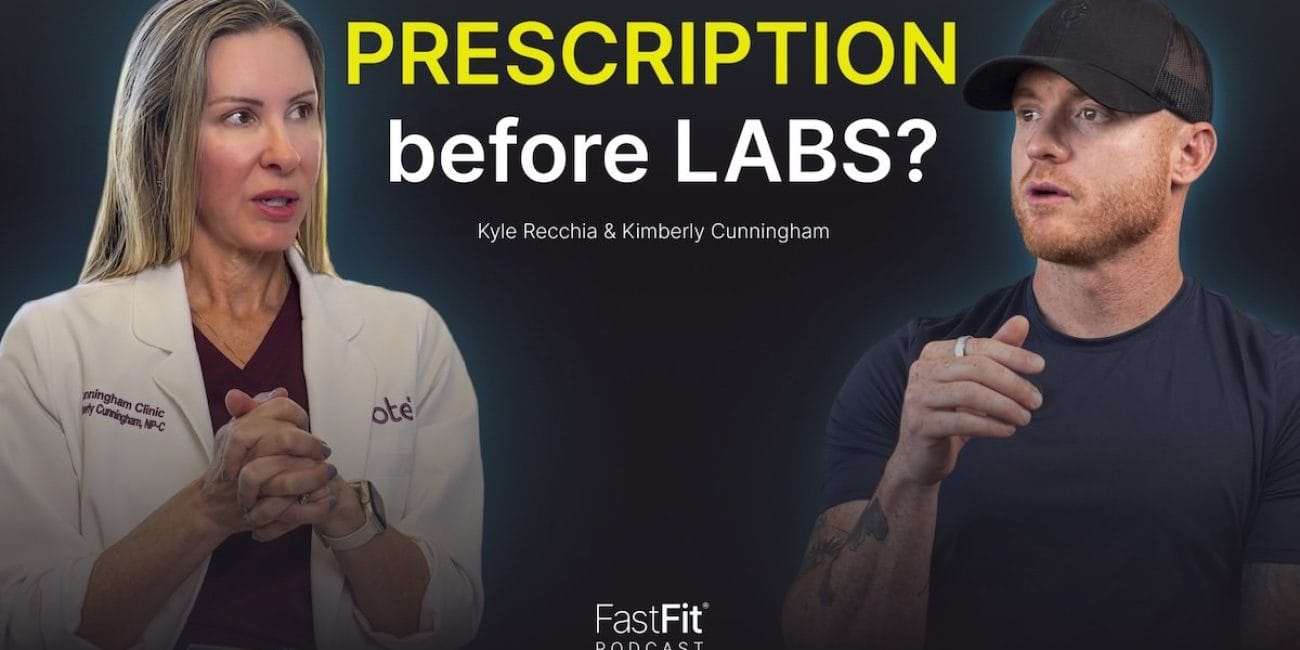
If a provider offers you a GLP without drawing labs first, find a different provider.
“A hammer can be wielded beautifully and also not so well. You need somebody who wants to think about the nuances.” — Kimberly Cunningham, Board-Certified Nurse Practitioner
This is the final episode in the three-part series that started when Instagram clips from Kimberly Cunningham’s earlier episodes crossed millions of views. Kyle and Kimberly wrap it up with the practical questions: how do GLPs actually work in practice, what should you watch out for, and where is all of this headed?
Kimberly starts by addressing the fears head-on. The side effects people associate with GLPs—nausea, constipation, gallbladder issues, pancreatitis—are overwhelmingly tied to dosing too aggressively. Any weight loss journey over 20 pounds carries increased gallbladder risk if the fat moves through the liver too quickly. Semaglutide (GLP only) is what she calls “inelegant and clunky.” Tirzepatide (GLP + GIP) is more complete, better tolerated, and effective at lower doses. Retatrutide (GLP + GIP + glucagon) is coming later this year for patients who are metabolically inflexible and resistant to tirzepatide.
The red flags section is critical. If a provider offers you a GLP without drawing labs, leave. The reason you need to lose weight may not be a peptide deficiency—it could be thyroid, hormone imbalance, or something else entirely. Kimberly told four women this week they couldn’t have tirzepatide because it wasn’t what was wrong. A good provider draws labs first, understands functional medicine, looks at the whole picture, and requires follow-up visits—not a fill-out-the-form-and-go model.
The episode also connects GLP/GIP deficiency to a broader pattern: three different diseases of inappropriate growth—endometriosis adhesions, PCOS follicles, and amyloid plaque in Alzheimer’s—all correlate with the absence of these peptides. Kimberly isn’t claiming they’re the same disease, but she finds the shared metabolic root deeply interesting and worth researching further.
She closes with her vision for the next five years: more peptides identified, more signaling deficiencies understood, more elegant and specific solutions. The goal is to keep going further up the cascade—finding where things went wrong first—so that fewer tools fix more problems downstream.
In this episode, you’ll learn:
- Why GLP side effects are almost entirely a dosing and prescribing problem—not a drug problem
- The difference between semaglutide, tirzepatide, and retatrutide—and when Kimberly reaches for each
- The number one red flag when finding a GLP provider: no labs before prescribing
- How GLP/GIP deficiency connects three diseases of inappropriate growth—endometriosis, PCOS, and Alzheimer’s—through shared inflammatory and immune pathways
- Why putting someone on a GLP they don’t need can cause the medication to bind elsewhere and create new problems
- What to look for in a provider: hormone balancing certification (BioTE, Access), functional medicine certification (IFM, A4M), and mandatory follow-up visits
- Kimberly’s five-year vision for metabolic medicine: more peptides, more elegant solutions, and getting closer to the source of dysfunction
🎧 Listen to the episode now:
→ Watch on YouTube »
→ Listen on Spotify »
→ Listen on Apple Podcasts »


