

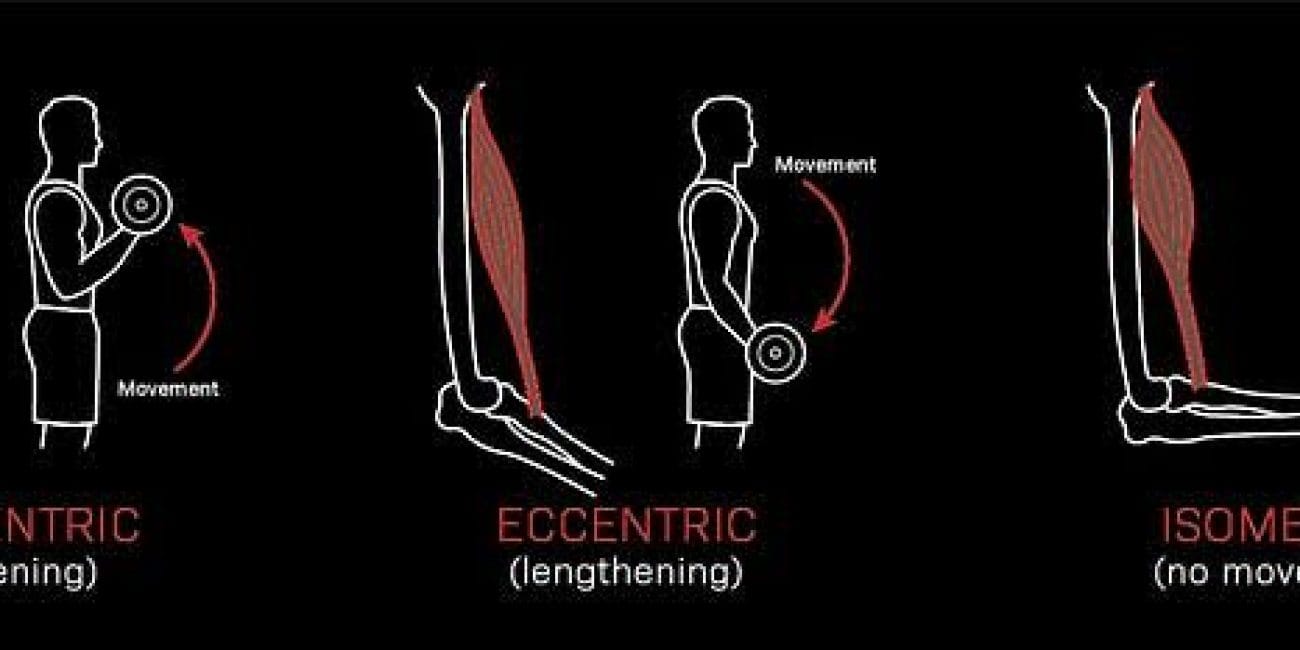
Describing the Active Muscle
You’ll often see the words “concentric” and “eccentric” used to describe the two primary phases of the contractions of the muscles during a set of exercise.
By the time you get to this Medium page you probably already know what those terms mean, and I assume that you do. But you know what happens when you assume!
So here now is an overview of just what the heck I’m talking about and why you should care.
“Concentric” Isn’t Just For Circles!
A muscle contraction is said to be “concentric” when the muscle in question is
- Actively producing force, and
- Becoming shorter in length
Examples of concentric contractions include
- The movement from the bottom of a biceps curl to the top position
- The movement from the top of a pulldown to the bottom position
- The movement from the bottom of a bench press to the top position
In each of the above cases, the muscles were active and becoming shorter in length. Concentric contractions are also colloquially referred to as “positive” contractions or “positives.”
“Eccentric” Is Weird No Longer
A muscle contraction is said to be “eccentric” when the muscle in question is
- Actively producing force, and
- Becoming longer in length
Examples of eccentric contractions include
- The movement from the top of a biceps curl to the bottom position
- The movement from the bottom of a pulldown to the top position
- The movement from the top of a bench press to the bottom position
In each of the above cases, the muscles were active and becoming longer in length. Eccentric contractions are also colloquially referred to as “negative” contractions or “negatives.”
Eccentric vs. Concentric
In normal, everyday weight lifting you lift and then lower the selected weight. That is, you typically perform a positive and a negative, with one of each in a consecutive pair being referred to as a “repetition.”
Some common distinctions between the two contraction types are:
- It is possible to produce more force during an eccentric contraction than a concentric contraction, resulting in greater mechanical tension (an essential part of the strength training stimulus).
- Concentric contractions require more oxygen consumption, and are more metabolically taxing (another essential part of the strength training stimulus).
- Eccentric contractions require about one sixth the oxygen consumption, but cause more physical damage to the muscle fibers (another essential part of the strength training stimulus).
- Eccentric contractions can be thought of as a “mechanical event” inside the muscle, while concentric contractions can be thought of as a “metabolic event” inside the muscle.
Yeah, So What?
That’s all well and good, but why should you care?
Well, remember that the stimulus we’re trying to deliver to the body is delivered primarily through these two types of contractions. If you’ll recall from this article, the three stimulating elements we’re trying to provide through positives and negatives are Mechanical Tension, Muscle Damage, and Metabolic Stress.
If we want to provide all three in roughly equal proportion, then we will perform both concentric and eccentric contractions, moving at the same speed during each.
To provide more of a strength/hypertrophy stimulus, we would focus on mechanical tension and muscle damage, while avoiding excessive fatigue. One strategy here would be to emphasize eccentric contractions and de-emphasize concentric contractions.
Options for this would be “negative-only work” where you exclude the concentric entirely, or even an emphasis on slower eccentrics so that a majority of the total time under load was devoted to the eccentric contractions.
To provide more of a metabolic/conditioning stimulus, we would focus on metabolic stress, at the expense of mechanical tension. A strategy here would be to emphasize concentric contractions and de-emphasize eccentric contractions.
Options for this would be “positive-only work” where you exclude the eccentric entirely, or even an emphasis on slower concentrics so that a majority of the total time under load was devoted to the concentric contractions.
This is why understanding the downstream effects of negatives and positives is important. Whatever your training goal is, you can manipulate the amount of either or both to more closely focus on producing the specific stimulus you’re after.
The Best Tool for The Job
And how do you get the most out of every positive and every negative contraction? By using resistance that matches your strength at all times.
Weights are always either under-loading or overloading the user, making weight lifting either inefficient or dangerous, respectively. So you never get the best concentric contractions possible when you’re lifting a weight, and you never get the best eccentric contractions possible when you’re lowering the weight. This mismatch means that the stimulus to the muscles is never as good as it could be.
With FastFit’s Responsive Resistance technology, however, you can get perfectly-matched resistance at all times. This means you are never under-loaded or overloaded. And that means your concentric and eccentric contractions are always of the highest-possible quality, producing the most potent stimulus your muscles can ever receive.
Housekeeping: Complete
And there you have it! This may have been “review” for some, but nevertheless it’s important to be speaking the same language and to have everyone on the same page when it comes time to discuss the more high-level topics we often discuss in our online educational materials.
Stay tuned for more.
–
Originally published by Jim Keen, Director of Education, on Medium.com


