

Safety Is No Accident!
An injury is an unacceptable result from exercise or athletic training. The whole point of the endeavor is to improve the health and physical capacity of the trainee, and an injury diminishes both.
In spite of the above, it is considered common and normal for people to complain about a bum shoulder that hurts from doing dumbbell flyes, an aching knee from their most recent leg day, or a bad back that has kept them from deadlifting for several months — and they look forward to deadlifting again soon!
So why is FastFit so much safer than lifting weights for the purpose of strength training?
Why is using FastFit perfectly safe for many populations who are too frail or inexperienced to lift weights without injury?
And how come you can train on FastFit for years and years without the usual tweaks, pulls, strains, and nagging injuries that are common with seasoned weight room users?
Well, there are four main reasons for this, and they are
- Matched Resistance
- Controlled Speed
- Form Discrepancy
- Proper Agency
Matched Resistance
An injury occurs whenever a muscle/joint system encounters a level of force that exceeds its structural capacity to absorb that force.
If you recall high school physics, you’ll surely remember that Force = Mass x Acceleration. The biggest safety feature of FastFit applies to the Mass element of this equation. In this context, you can consider the Mass to be “the resistance encountered by the user.”
With a weight, the resistance encountered by the user is static. That is, it never changes. One hundred pounds is always one hundred pounds, and does not adapt or respond to the user.
The way these static weights are typically used is that the user selects a weight that is well below the amount of weight that can be lifted just once (the “one-rep max”) so that the weight can be lifted twice, three times, or for as many repetitions as the user desires.
So the weight selected is purposely mismatched to the user for both convenience and practicality. You’re underloaded and there’s no way around it, unless you want to limit yourself to one-rep maxes.
And even then, good luck guessing what weight to use each time. Even worse, this mismatch is “baked into the cake” and unavoidable.
However, this mismatch between the weight being lifted and the user’s strength — while necessary for convenience and practicality — introduces a huge problem for safety.
So this causes inefficiency, which is undesirable, but is it dangerous? Well, if the mismatch can cause the weight to be less than the user’s capacity, what happens if the mismatch causes the weight to become more than the user’s capacity?
An injury, that’s what happens!
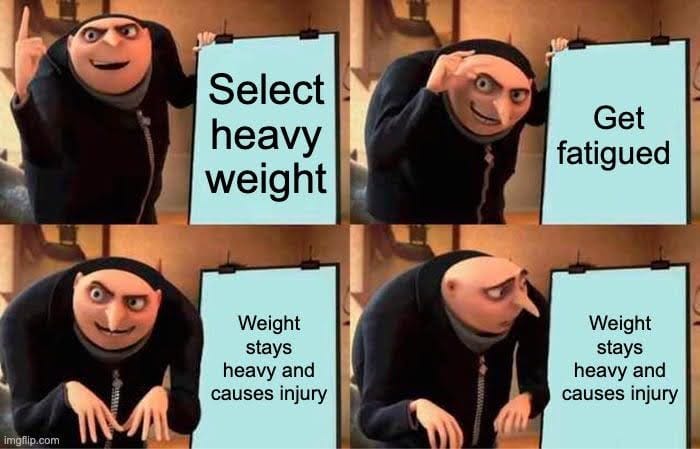
Fatigue is desirable, but causes increased risk of injury when weight lifting
There are two primary ways this unavoidable mismatch problem causes injury. The first is that the user simply selects a weight that is too heavy to begin with, and when the attempt is made to lift it, an injury is produced.
The second and more common way a mismatch causes injury is that the user becomes fatigued over the course of a set and eventually encounters a situation where the weight that was appropriate on the first few reps becomes inappropriately heavy during the final reps as the user’s strength wanes.
When the user experiences fatigue (which is desirable as part of the exercise stimulus) and the strength level drops below the level of weight that was selected for the exercise, an injury is produced in response to this overload.
FastFit completely avoids this situation by providing perfectly-matched resistance at all times. There is no more overloading or underloading of the user. FastFit creates a situation where the resistance can never become excessive. This is the biggest safety feature of our technology.
If you can handle large amounts of mechanical loading at the beginning of your sets, you get that level of loading. And not an ounce more.
If you can’t handle much mechanical loading towards the end of your set or your workout, you still only get as much as you can withstand. The resistance you encounter is changing moment by moment to accommodate your momentary level of strength.
Any tool that uses gravity as its mechanism to provide resistance — or has a form of resistance that can be pre-selected — has the unavoidable possibility of overloading the user, providing excessive levels of resistance.
This applies to all modalities measured in “weight” (free weights, weight stack machines, bodyweight movements, etc), all elastic forms of resistance, and anything else you can name that is not proactively adapting and responding to the user’s force output.
Controlled Speed
The next element of the F = MA equation is the “A” for acceleration. Acceleration is the rate of change in velocity.
Large changes in acceleration primarily occur at the beginning of a repetition as the user goes from a fixed position into motion, and at the end of a repetition — the “turnaround” — as the user decelerates, arrives once again at a fixed position, and then accelerates in the opposite direction.
Looking at the formula, you can see that the greater the acceleration, the greater the total amount of force the user will encounter. And if an injury occurs when the force encountered exceeds the user’s capacity to absorb that force, the goal of reducing force can be accomplished by reducing excessive acceleration.
This is the primary reason that rapid, ballistic movements are not recommended for exercise. All things being equal, a greater acceleration increases the forces encountered by the user’s joints and connective tissues.
This is the precise opposite of what we’re after if safety is a priority.
However, with traditional tools, it’s a necessary evil. How are we supposed to place a large force demand on the muscles?
As we discussed in the previous section, when we lift weights we’re forced to underload ourselves. The M in F = MA is limited because of this necessity of underloading. So how do we increase F?
Well, in that case we are forced to increase A! When lifting weights we must produce dangerous levels of acceleration for the purpose of giving our muscles the necessary stimulus, and there’s no way around it when using a gravity-based form of resistance.

This is another area in which FastFit shines. The speed is computer controlled, the turnarounds are performed perfectly every time by our finely-tuned motor that controls acceleration/deceleration, and the user cannot possibly mess it up.
The user gives up none of the force production possible in the muscles in the process, since the resistance is always giving the user exactly what is needed at all times. Never underloaded, no matter how slowly you’re going.
Form Discrepancy
If you have a weighted bar placed on top of your spine, a mistake in your form can put you in a world of trouble very quickly.
If you are lifting hundreds of pounds off the ground and make a mistake in the alignment of your body, you can suffer an injury that will be with you for the rest of your life.
With weights — especially as you use heavier and heavier weights because you’re getting stronger — a form discrepancy can be a death sentence at worst, a tragedy some other times, and debilitating at best.
Anyone who has spent much time in weight rooms knows a few people who have dealt with exercise-related injuries with effects lasting weeks, months, and sometimes years.
As we’ve said, an injury is an unacceptable result of exercise. So why do we still have thousands of injuries each year from this activity?
Well, in the same way that we move rapidly during exercise even though it increases the risk of injury, this situation is a necessary evil. Until recently there simply wasn’t a better way to deliver a resistance exercise stimulus than using weights that have the potential to overload the user.
It’s very similar to asking why people in the early twentieth century drove cars with no airbags, no power steering, no seat belts, and so forth. It was the best they had available, and the advantages of the horseless carriage outweighed the risks. It’s the same with weight room enthusiasts today.
With FastFit, a mistake in the user’s form is no longer a cause for concern. To be sure, resistance exercise is less effective with sloppy form, so we recommend a body alignment that allows for maximal mechanical loading in a safe format. Good form still matters.
What we’re saying is that improper form — while less effective — is no longer very dangerous.
If you’re exerting against a weight and your form slips, the weight you selected is still the weight you selected. And now it’s being applied not to your strong, aligned frame, but instead to your misaligned frame that doesn’t have nearly the force-absorbing capacity. So an injury is produced.
However, if you’re exerting against an FastFit machine and your form slips, the resistance you encounter will respond to you and diminish instantly to match your ability — with your momentarily-misaligned body — to produce and absorb force.
There is still no way you can become overloaded, and there is still no way you can encounter a level of force that will exceed your structural capacity to absorb force. So an injury is avoided.
Even seasoned lifters with decades of experience produce injuries from mistakes in form. Even Olympians suffer injury from form discrepancy. What chance do the rest of us have if these people can’t lift weights for resistance exercise without injury?
With FastFit it’s simply not an issue. Users can work on their form and get the most out of their resistance exercise without being worried that an inevitable slip-up will sideline them for weeks or more.
Proper Agency
Back before people understood how FastFit worked, a common critique was something like this:
“I don’t like that the machine is acting on the user. I prefer weights, where I act on the weight to lift it and lower it, putting me in total control all the time. I think having the machine move you through a range of motion is inherently dangerous.”
This critique is well-meaning but misinformed. I say this because, in fact, the precise opposite situation exists.
As soon as you lift a weight, you have made a commitment to lower that weight. Once it is lifted, it is acting on you 100% of the time, often in situations where disengaging suddenly — like in the case of physical pain — can cause injury.
You are now in a situation where the weight can apply force to you even when you no longer desire for the force to be applied. You have lost your agency.
Once the weight is lifted, it’s trying to get to the center of the Earth, and you’re in the way.
In the bench press, your neck is in the way.
In the barbell squat, your spine is in the way.
Regardless, this weight is acting on you all of the time until you successfully return it to its resting place. This is why there is always a small burst of relief as you unburden yourself at the end of the set.
You intuitively understand that there is a non-zero chance that you could have failed to do so, and the weight — which is always acting on you through gravity — would have had its way with you as Isaac Newton described a few hundred years back.
With an FastFit machine, this situation is reversed. The force you encounter is always perfectly proportionate in response to force that you yourself have voluntarily applied.
There is never a situation where an FastFit machine can apply force to you even when you no longer desire for the force to be applied. You have complete agency and control over your experience.
The moment you stop exerting, the resistance drops to zero. This is, of course, a safer situation than the one previously described with weights.
So you see that the situation is the precise opposite of the former critique. In actual fact, weights are acting on you 100% of the time through gravity, even when you no longer desire their resistance.
A FastFit machine, on the other hand, is 100% voluntary, and can only apply resistance to you when desired, in response to your force output, and is instantly responsive to any voluntary changes you produce.
FastFit: The Safest Choice For Your Training
There are thousands of emergency room visits all over the world each year that are associated with the use of weight rooms. And even though an injury is an unacceptable result of exercise, the masses still believe that weights are the best tool available for the purpose of resistance exercise.
FastFit represents a giant leap forward for safety in exercise. Our technology enables us to retain and surpass all of the benefits possible through the use of gravity-based forms of resistance, with none of their safety risks.
FastFit’s matched resistance creates an unprecedented situation in which the resistance encountered by the user can never become excessive, while the use of weights ensures that the user will eventually suffer exactly this type of dangerous mismatch.
FastFit’s controlled speed ensures that the user no longer needs to put their joints and connective tissues at risk of injury in pursuit of greater force demand for their muscles, while the use of weights ensures that the user must move at dangerous speeds to achieve the desired muscular stimulus.
FastFit’s responsive resistance turns form discrepancies into mere harmless annoyances, while the users of weights must continually exercise in fear of the major injuries that can occur with even one significant mistake in technique.
FastFit’s voluntary conditions of exertion mean that the machine can never act upon you, only in response to you, while weights are acting upon you 100% of the time through the entirety of their use.
It’s now easy to answer the question: why is FastFit so much safer than weight lifting?
–
Originally published by Jim Keen, Director of Education, on Medium.com


