

The Bone Density Status Quo
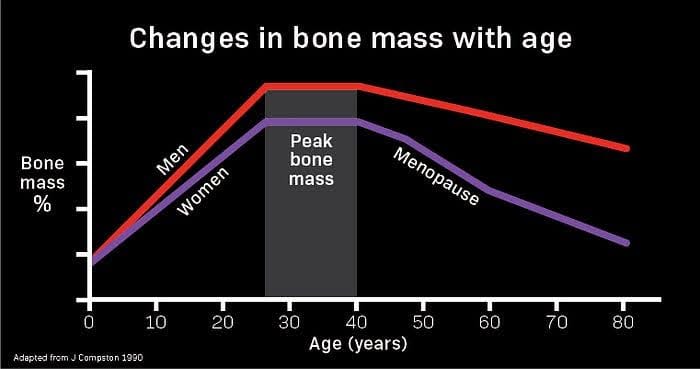
For some reason, it is considered normal to begin declining at a certain age as your health and strength gradually diminish towards decrepitude and loss of function.
Through decades of disuse and atrophy, you experience a loss of skeletal muscle mass, quality, and strength.
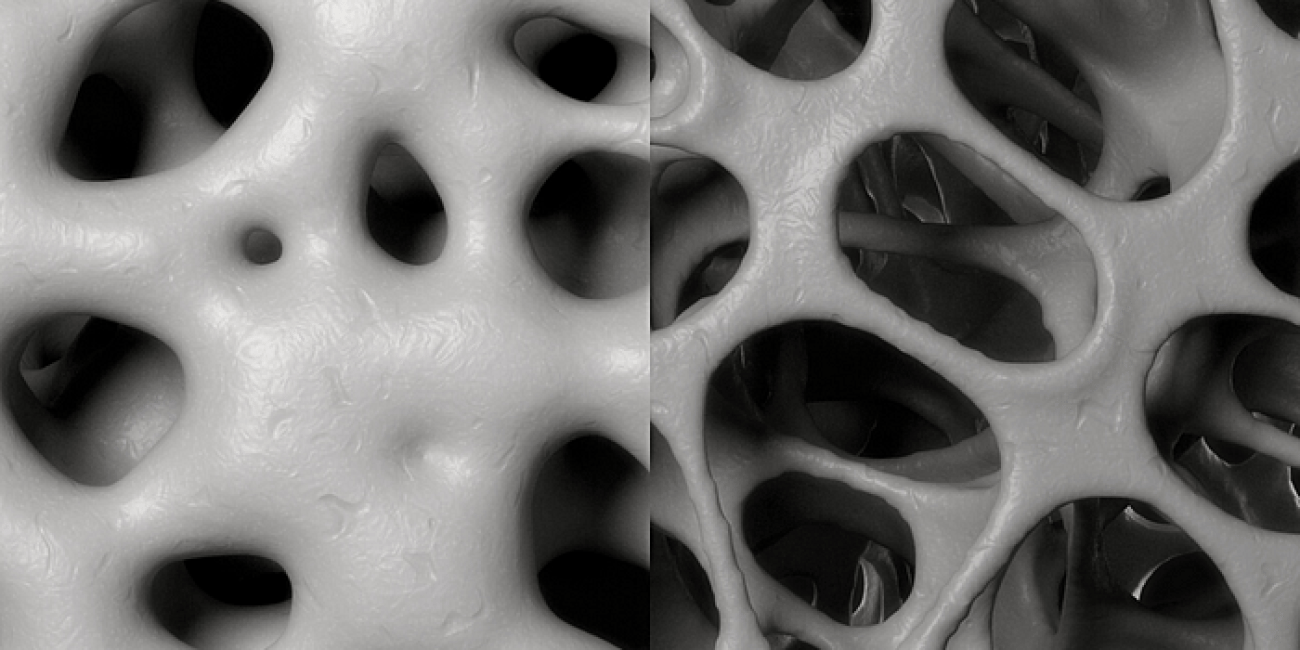
This leads progressively to Osteopenia, the loss of bone density. As these conditions persist, Osteoporosis is eventually produced, and the sufferer becomes prone to falls, diabetes, and myriad other conditions that affect people in their Golden Years.
Bone Loss Is a Bigger Problem Than You Think
Sounds bad, right? You have no idea. Over ten million Americans have Osteoporosis, with another forty-four million experiencing low bone density, placing them at increased risk.
One in two women and up to one in four men will break a bone in their lifetime due to Osteoporosis.
For women, the incidence is greater than that of heart attack, stroke, and breast cancer combined.
Osteoporosis-related bone breaks cost patients, their families, and the healthcare system $19 billion annually. By 2025, it is predicted that Osteoporosis will be responsible for more than three million fractures resulting in $25.3 billion in costs.
In 2019, just over sixteen percent of the American population was sixty-five years old or older; a figure which is expected to reach twenty-two percent by 2050. This is a significant increase from 1950, when only eight percent of the population was sixty-five or older.
Worldwide, over 200 million people suffer from Osteoporosis.
So the bone and muscle loss associated with aging is getting progressively worse, and the proportion of our population who is at an advanced age is increasing over time.
Is Osteoporosis Preventable?
So what’s the fix? Well, there is plenty of good research showing how we can stop and even reverse this degenerative process:
- Mechanical loading is the primary stimulus for the growth and maintenance of bone density.
- For most effective bone mass increase, dynamic — “moving” — contractions are most beneficial.
- Eccentric loading — mechanical loading as an active muscle lengthens — is best for increasing bone mineral density.
It’s important for an aging population to understand that resistance exercise provokes an increase in bone density. The mechanism is pretty cool.
A “Piezoelectric effect” happens when a material produces electric charge as mechanical stress is applied to it.
The collagen molecules in your bones are made up of charge carriers. When a bone is mechanically stressed, the charge carriers go to the bone’s surface. When this happens, piezoelectricity is produced.
When a bone produces piezoelectricity due to the mechanical loading applied to it, electrical dipoles are formed. Electric dipoles attract osteoblasts, the cells that build bones.
Osteoblasts deposit calcium and other minerals on the part of the bone that is stressed. This increases the density of the bone.
Piezoelectricity is good for bones because it can repair and heal them. Bones can also be remodeled with the help of piezoelectricity. This was discovered in 1892 by Dr. Julius Wolff. This effect of piezoelectricity to bones is also called Wolff’s Law.
So what is it that can apply physical pressure to provoke a piezoelectric effect in the bone to stimulate the formation of new bone tissue?
The answer again: “mechanical loading of the bones and muscles.”
The Best Exercises for Bone Health
The question then is, what is the safest, most efficient, and most effective way to mechanically load the bones and muscles?
Out of all the modalities of exercise that might be used for this purpose, it’s obvious that resistance exercise is the best option since it provides greater mechanical loading than yoga, “cardio,” spin classes, swimming, and so on.
Common resistance exercise options include:
- Bodyweight exercises and calisthenics
- Elastic band workouts
- Weight lifting with free weights
- Weight lifting with weight stack machines
- Pilates
- Plyometrics and gymnastics
- FastFit
The final question then: out of all the methods and tools listed above, which is the most efficient and most effective? And since we’re talking about an aging population, which is the safest, most convenient, and easiest to learn?
This is where FastFit comes out way ahead of any other available resistance exercise tool.
First, just in terms of effectiveness, FastFit is head and shoulders above other modalities because its optimally-loaded eccentric contractions permit the greatest magnitude of mechanical loading possible for every user every time.
You can’t achieve the same levels of mechanical tension and loading with weights because you’re limited to the amount of weight you can lift in the first place, completely missing out on the potential amount of weight you could have accommodated on the way down.
Second is the matter of time efficiency. Using FastFit, an improvement in bone density can be stimulated in a session lasting not longer than ten minutes and performed once every 7–14 days.
This represents a small fraction of the time commitment necessary to achieve a similar result using gravity-based tools like weights.
Third, safety. Because FastFit’s resistance can never inappropriately load the user, it is far, far safer than any other resistance exercise modality.
Its adaptive/responsive nature means that the user can never be acted upon involuntarily by the resistance being used, unlike a weightlifting scenario where the weight is acting on you 100% of the time whether you like it or not.
And finally, convenience and ease of use. A FastFit protocol for the purpose of restoring and building bone density requires no coordination, no balance, no agility, and very little skill acquisition.
You can experience meaningful levels of mechanical loading at your very first session, unlike other modalities that require several weeks of slow practice before enough competence is gained to add enough weight to the movements.
FastFit rapidly gives you the desired results with a minimum of learning curve.
Our Bone Density Problem: Solved
So there you have it. Osteoporosis is a huge problem, it can be completely solved by a regimen of meaningful mechanical loading of the bones, and the best modality for this purpose is resistance exercise.
If you’ve understood all that to be true — and you understand the inherent advantages of FastFit over any other currently-available tool for resistance exercise — then the unavoidable conclusion is that FastFit technology is the best tool to use for the purpose of recovering lost bone mass, building new bone mass, and completely avoiding the Osteoporosis associated with aging.
–
Originally published by Jim Keen, Director of Education, on Medium.com


