

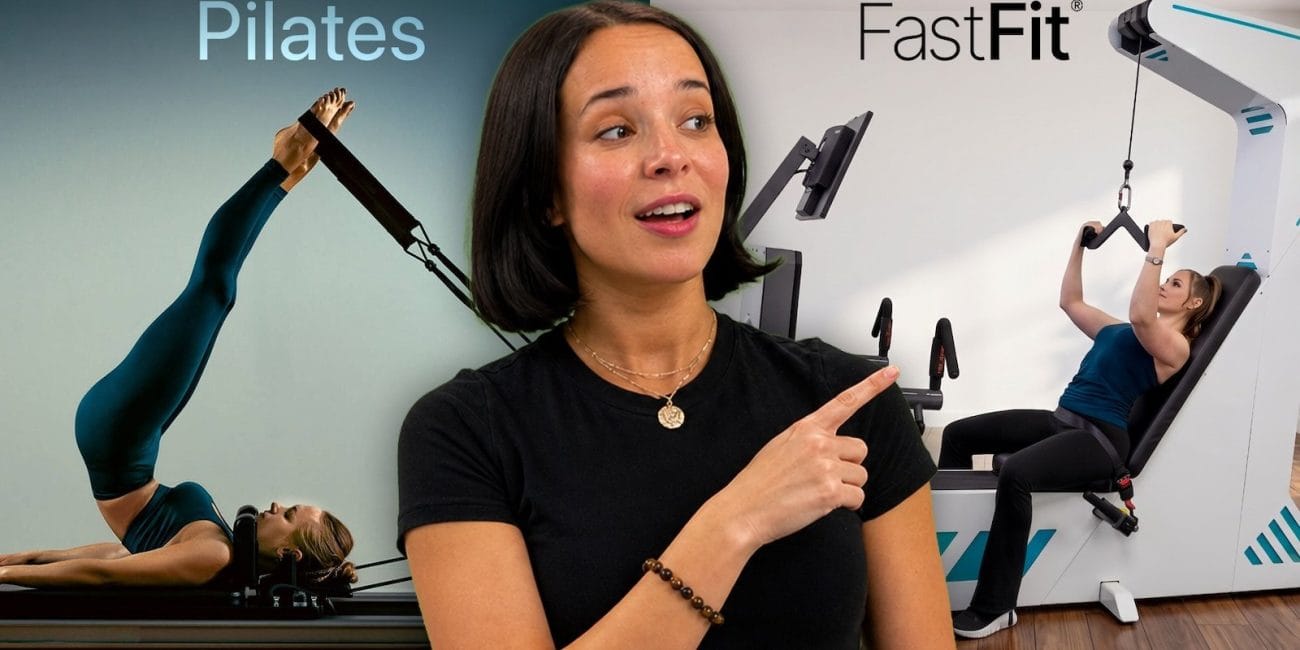
Pilates is everywhere right now. Mat or Reformer—doesn’t matter. Your friends are doing it, your Instagram feed is full of posts about it, and you’ve probably been to a class or two yourself. So how does it compare to FastFit for women over 40? Is there a clear winner for building strength, improving cardio, and losing weight?
We get these questions all the time. You might be surprised with our answer. Because it isn’t “FastFit is the only option.” The two actually make each other better, even if one is meaningfully better for building muscle.
How do FastFit® and Reformer Pilates actually work?
FastFit uses isokinetic exercise technology to deliver a high degree of muscle stimulus in a short time. The machine moves at a constant velocity while you produce force against it through the full range of motion, both concentric and eccentric. Workouts are full-body, coached, and private: 20 minutes, two to three times per week.
Reformer Pilates uses spring-based resistance with an emphasis on controlled movement, core engagement, flexibility, and body awareness. Sessions typically run 50 to 60 minutes in a coached, group setting, with relatively low cardiovascular stress.
The core differences (pun intended) come down to the type of resistance, the intensity of muscle stimulus, and the time required.
Which Is Better for Losing Weight and Body Recomposition: FastFit® or Pilates?
This is where the research gets interesting. A 12-week randomized controlled trial conducted by Western Colorado University compared isokinetic resistance training (the same machines used by FastFit) to traditional free-weight training. The FastFit group reduced body fat from 27.3% to 22.9%, a 4.4 percentage-point drop, while the traditional weightlifting group went from 27.7% to 26.0%. Waist circumference dropped 2.1 cm in the FastFit group compared to 0.5 cm for traditional weights (Dalleck et al., 2021).
On the Pilates side, the most relevant Reformer-specific study found no significant changes in most body composition measures after 8 weeks of twice-weekly, 60-minute sessions (Yilmaz et al., 2022). A broader Pilates meta-analysis found an average body fat reduction of about 4.2 percentage points, but that included mostly mat Pilates protocols, not Reformer-specific evidence (Ye et al., 2021).
Which Is Better for Improving Cardiovascular Fitness?
This was perhaps the most surprising finding from the WCU study. The FastFit group improved VO2max from 34.1 to 39.3 mL/kg/min, a 15.2% improvement and 3.5 times the gain seen in the traditional weights group. The American Council on Exercise flagged this as notable because VO2max improvements are typically associated with cardio training, not resistance training.
By comparison, a Pilates meta-analysis found a more modest mean VO2max difference of 2.77 mL/kg/min versus control groups (Torres-Costoso et al., 2019). Pilates can improve cardiorespiratory fitness in deconditioned populations, but the magnitude isn’t comparable.
How Does the Time Investment Compare?
The FastFit group in the WCU study averaged about 15-minute sessions, twice per week, for roughly 30 to 45 minutes of total weekly training. The traditional weights group trained for about 45 minutes per session, two to three times per week. Reformer Pilates sessions typically run 50 to 60 minutes (Yilmaz et al., 2022).
Calorie burn per session may be comparable in absolute terms: roughly 105 to 175 kcal for a FastFit session versus about 155 kcal for a 60-minute Reformer session (Andrade et al., 2020). But FastFit compresses that expenditure into a fraction of the time.
Pilates Still Has Its Place
None of this means Pilates isn’t worthwhile. The Yilmaz study found real improvements in performance tests, HDL cholesterol, fasting blood glucose, and insulin. Pilates adherence rates are strong, with mean attendance around 88.2% in supervised settings (Torres-Costoso et al., 2019), and user reviews consistently highlight enjoyment, body awareness, posture improvements, and mental health benefits.
If you love Pilates and it keeps you moving, that’s genuinely good. And even if you’re considering trying out FastFit, we wouldn’t try to persuade you to drop your Pilates routine.
But it’s important to emphasize that Pilates and FastFit don’t do the same thing. You can’t equate Pilates with progressive-overload strength training when your goal is building muscle, preserving bone density, and changing body composition.
Why a Pilates Background Makes You Better Equipped for Isokinetic Strength Training
But here’s the real reason why Pilates and FastFit® and Pilates work so well together. If you’ve been doing Pilates for any length of time, it’s actually going to make you better prepared to handle the intensity and movements on the FastFit® machine.
Pilates isn’t just a workout. It’s a methodology. Concepts like deep core activation, shoulder girdle control, breath work, and precise, intentional movement carry over into every kind of physical training—including isokinetic resistance work at FastFit®. Members who come to us with a Pilates background arrive with something that takes months to build in most new clients: excellent body awareness.
That translates directly into better outcomes:
- Faster progression. Because we don’t have to spend weeks correcting basic form, we can move into high-effort muscle-building work sooner.
- Lower injury risk. Body awareness is one of the strongest predictors of safe training under load.
- Better mind-muscle connection. The kind of focused, intentional movement Pilates teaches makes every rep on the FastFit® machine more effective.
Our trainers actively integrate Pilates concepts into FastFit® sessions where they make sense. If you’ve spent time on a Reformer, you’ll recognize this—even if we don’t always call it out by name.
And it works both directions. Members who start conditioning at FastFit® twice a week often report noticeable improvements in their Pilates classes, too. The added strength shows up in harder-to-reach positions, longer holds, and more control across the board.
Pilates and FastFit® aren’t in competition. They make each other better.
For Women Over 40, Put the Big Rocks in First
Muscle is medicine. It protects your metabolism, your bones, and your independence as you age. Adults lose 3 to 8% of muscle mass per decade after age 30 if inactive, and that loss accelerates the metabolic and hormonal shifts that make midlife feel so challenging.
If you only have two hours a week for exercise, spend 40 minutes on progressive resistance training like FastFit® and use the remaining time however you want: Pilates, walking, yoga, whatever keeps you moving, whatever helps you feel complete the picture of health you envision for yourself.
Our encouragement: Don’t reverse that priority. The question isn’t “which burns more calories” but “which builds and preserves the most muscle per minute invested.” The evidence clearly favors isokinetic resistance. It’s the first domino that affects everything else.
If you’re leaning toward Pilates because it feels gentler, that’s understandable. But isokinetic technology is used in rehabilitation settings precisely because of its safety profile. FastFit trainers can personalize your workout, giving you a safe pathway into strength training for the first time or if you’re coming back from injury.
The Bottom Line
FastFit is the better primary modality for efficient body recomposition, real-world strength, and cardiovascular fitness. Pilates is a genuine complement—one that can actually accelerate your progress at FastFit, and get better because of it. For women over 40, prioritize the muscle first, then layer in whatever else you enjoy.
Remember: the enemy is the couch, not a different modality.
Ready to get started prioritizing muscle? Schedule your FREE intro session here.
Citations
- Andrade, L.S. et al. (2020). Energy expenditure and intensity of Reformer and mat Pilates. Journal of Bodywork and Movement Therapies.
- Dalleck, L.C., Dalleck, A.M., & Byrd, B.R. (2021). Personalized, adaptive resistance training is superior to traditional resistance exercise: A randomized, controlled trial. International Journal of Research in Exercise Physiology, 16(2). Read the full study
- Rayes, A.B.R. et al. (2019). The effects of Pilates vs. aerobic training on cardiorespiratory fitness, isokinetic muscular strength, body composition, and functional tasks outcomes in overweight and obese adults. PLOS ONE.
- Torres-Costoso, A. et al. (2019). The effect of Pilates on cardiorespiratory fitness: A meta-analysis. Journal of Clinical Medicine.
- Ye, X. et al. (2021). Effectiveness of Pilates on body composition in overweight and obese adults: A meta-analysis. Medicine.
- Yilmaz, G.D. et al. (2022). Effects of Reformer Pilates on health-related parameters: A randomized controlled trial. European Journal of Integrative Medicine.


