

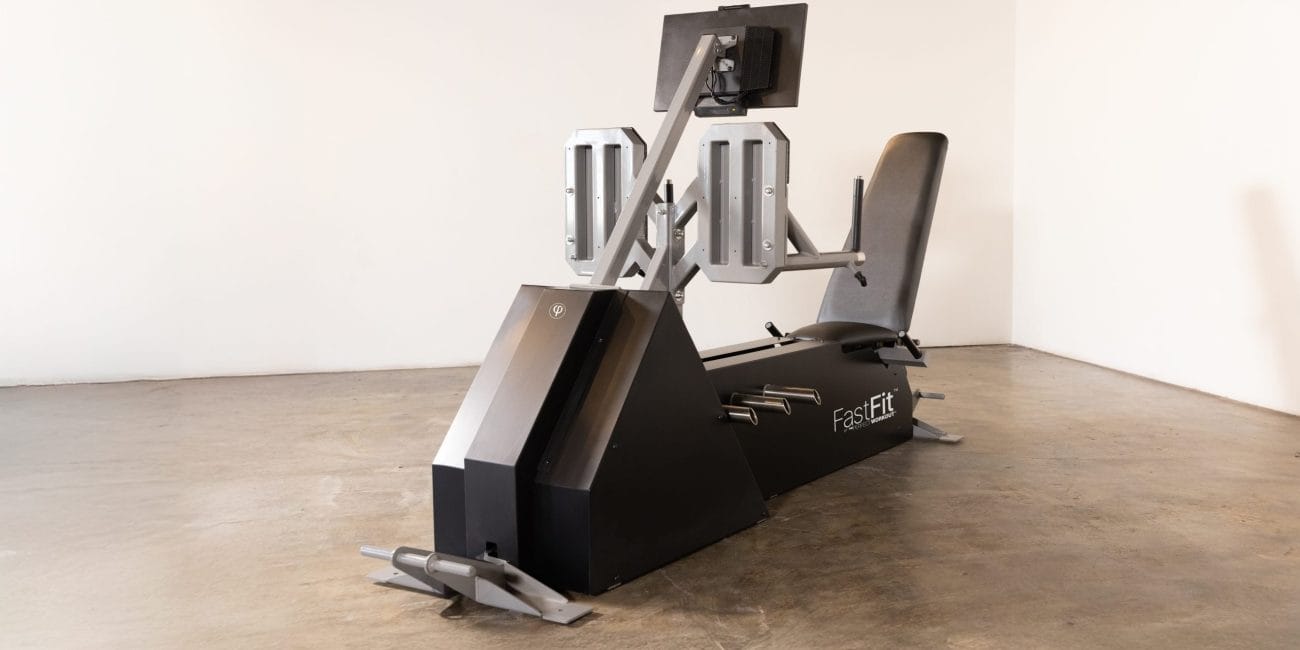
The Perfect Workout’s FastFit technology was put to its first major research test which has now been published in the Journal of the American Council on Exercise.
The researchers pitted a weight-lifting group against a group of FastFit users, and the results were…better than we could have hoped.
Setting The Stage
The study was conducted by Lance Dalleck, PhD, and his team of researchers in the High Altitude Exercise Physiology Program at Western Colorado University.
All participants completed baseline testing that consisted of the following:
- Muscular fitness: one-repetition maximum (1-RM) and five-repetition maximum (5-RM) for all exercises that were to be included in the study
- Basic anthropometric measures: height, weight, waist circumference, and body composition
- Cardiorespiratory fitness: Maximal oxygen uptake (VO2max)
They randomized the participants into three groups: a control group who did no exercise, a Weight Lifting group, and a FastFit group.
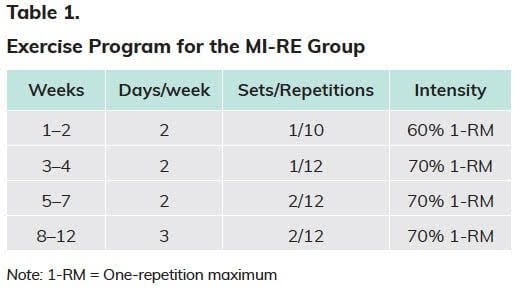
The Weight Lifting group performed a full-body resistance-training program that adhered to standard industry guidelines (see Table 1). The following exercises were included in the program:
- Bench press
- Shoulder press
- Lat pull-down
- Seated row
- Biceps curl
- Triceps push-down
- Seated leg press
- Seated leg extension
- Prone lying leg curl
- Seated back extension/flexion
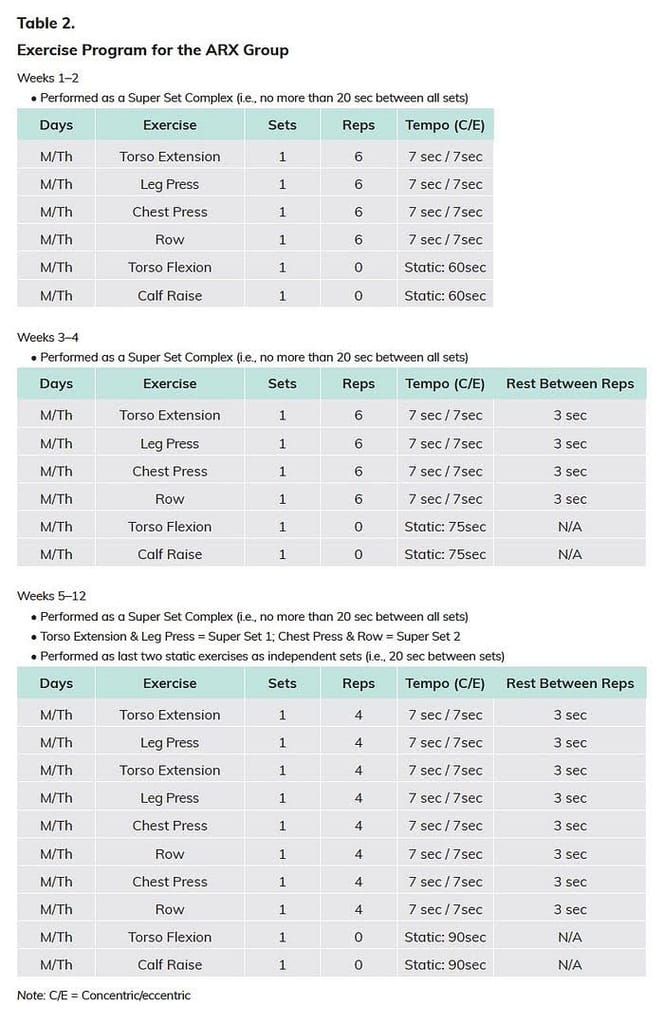
The FastFit group performed a full-body routine using the FastFit Pro (note: the FastFit group is labeled as “ARX” after the FastFit technology’s original manufacturer).
The Proof of The Pudding Is In The Eating
The nitty-gritty number crunching can be found by following the link at the beginning of this summary. Here are some brief notes of the differences between the Weight Lifting group and the FastFit group.
The Weight Lifting group and the FastFit group both made improvements over the 12-week study, however…
- The FastFit group saw almost twice the strength gains of the Weight Lifting group in less than a third of the time.
- The Weight Lifting group spent 3.5X the workout time of the FastFit group over twelve weeks.
- The FastFit group spent 72% less time exercising than the Weight Lifting group (6 hours vs. 21 hours over 12 weeks)
- The FastFit group achieved 2.5X the fat loss of the Weight Lifting group.
- The FastFit group added twice the amount of lean mass that the Weight Lifting group added.
- The FastFit group achieved 4.2X the waist circumference decrease of the Weight Lifting group.
- The FastFit group achieved 2.6X the body fat percentage decrease of the Weight Lifting group.
- The FastFit group achieved 3.5X the VO2Max increase of the Weight Lifting Group.
- FastFit showed 90% better strength results than weight lifting in 28% of the time commitment.
A Picture Worth 1,000 Words
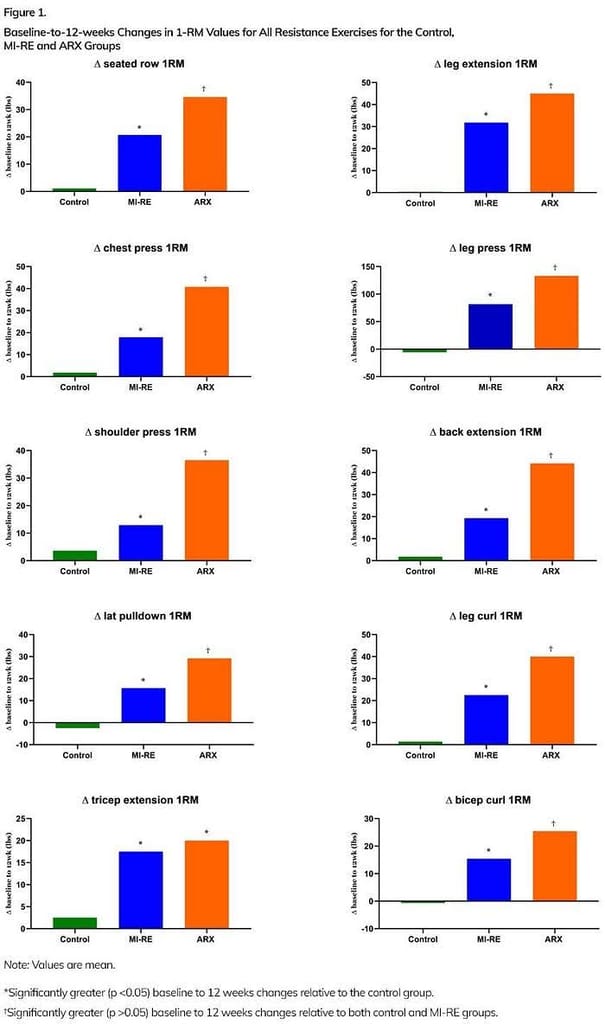
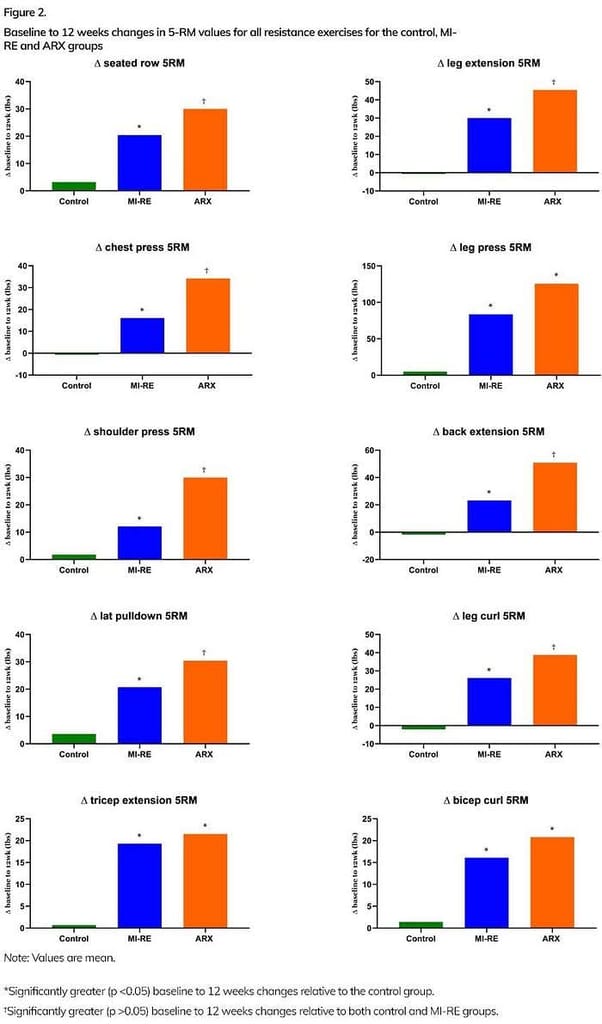
Check out these bar graphs from the study displaying the relative differences between the three groups, first in the one-rep max test and then in the five-rep max test. See if you can tell which group came out on top (note: the FastFit group is labeled “ARX” after the name of FastFit’s original manufacturer).
But It’s Even Better Than It Looks
The one-rep max and five-rep max tests both involved weight lifting movements. So the Weight Lifting group was practicing the test for twelve weeks, while the FastFit group was only doing FastFit.
This is a confounding variable, since we would expect an added advantage for the group who was not only increasing their raw strength through weight lifting, but also receiving the motor learning and neurological skill acquisition that come from practicing the skill of lifting the weights through space.
But even with that added advantage, the Weight Lifting group did not come close to the improvements seen by the FastFit group.
“Yeah, But…”
There are a few opportunities for further study as we attempt to compare FastFit’s performance to other weight lifting protocols.
Here now are some objections to the present study, and our responses:
Objection: “Well it’s no wonder the FastFit group did better. The Weight Lifting group only used 60% and 70% of their one-rep max weights during the study. The FastFit group was using 100% voluntary effort the whole time. Greater mechanical loading intensity = greater results.”
Response: I agree that it’s a feather in FastFit’s cap that 100% intensity is so easily achievable that even novice users could safely do it. It’s a bit like saying, “Of course your car won the race against my horse! The horse can’t go as fast!”
Well, yeah. That’s why the car will always win.
However, the researchers attempted to make up for this intensity discrepancy with increased workout volume in the Weight Lifting group.
There is some precedence for this, as this study showed no difference in lean mass gain between groups that were lifting heavy or lifting light, so long as they controlled for total volume.
But in the current study the FastFit group doubled the lean mass increase of the Weight Lifting group, even though the Weight Lifting group more than tripled the workout volume of the FastFit group. So there’s something else going on.
Objection: “The Weight Lifting group was doing an ineffective protocol. A [hypertrophy/powerlifting/SuperSlow/etc] protocol would have yielded a better result.
Response: The Weight Lifting group’s protocol was designed around the American Council for Exercise guidelines for strength training. In other words, if someone wants to begin strength training, what should they do?
So it wasn’t designed for a specific purpose like muscle growth, maximum strength, or anything like that. It was designed for general strength and fitness, to acquire all the benefits of strength training.
To make it fair, the FastFit protocol was also not designed to maximize any specific response. It was just our general, basic routine. Just like the Weight Lifting group’s general, basic routine.
The FastFit group doubled the muscle gain of the Weight Lifting group, even though neither group was doing a protocol to maximize muscle gain.
The FastFit group doubled the strength increase of the Weight Lifting group, even though neither group was doing a protocol to maximize strength increase.
And so on. Plus, remember, the FastFit group exercised for a total of six hours over the twelve weeks, while the Weight Lifting group exercised for a total of twenty-one hours!
Looking Ahead
In the famous words of so many researchers…more study is needed!
We want to see a Weight Lifting group doing a hypertrophy protocol up against a FastFit group doing a hypertrophy protocol.
We want to see a Weight Lifting group doing a strength protocol up against a FastFit group doing a strength protocol.
And so on. The reason FastFit will always come out on top is because FastFit maximizes every component of the exercise stimulus, without compromise or restriction.
Welcome to the 21st century of exercise!
–
Originally published by Jim Keen, Director of Education, on Medium.com


