

Walk into almost any gym and you’ll see the same handful of movements repeated in slightly different forms. What you won’t see is anyone explaining the mechanics underneath them. That’s a missed opportunity, because the type of resistance you train against plays a more significant role in your results than most people realize.
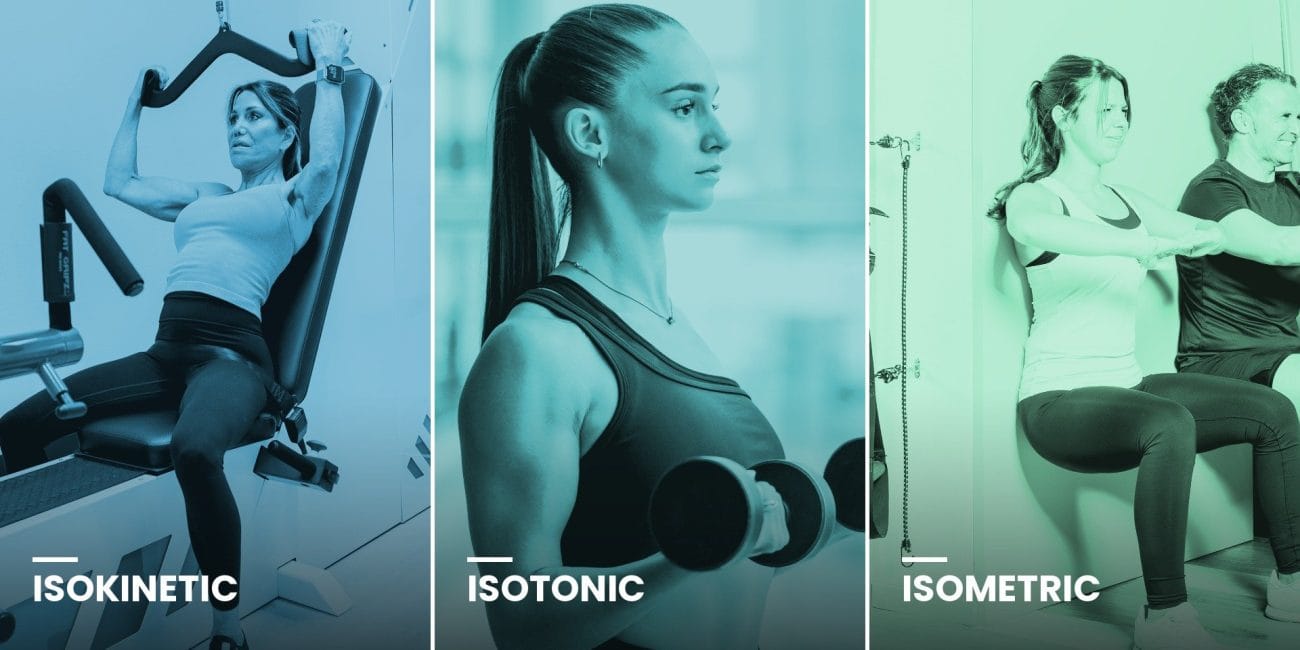
There are three broad categories for almost every form of strength training. They share the same prefix—”iso,” meaning “same”—and the word that follows tells you exactly what’s being held constant.
Here’s the short version. We’ll unpack each one below.
Isometric: same length.
Isotonic: same tension.
Isokinetic: same speed.
Isometric: Tension without Movement
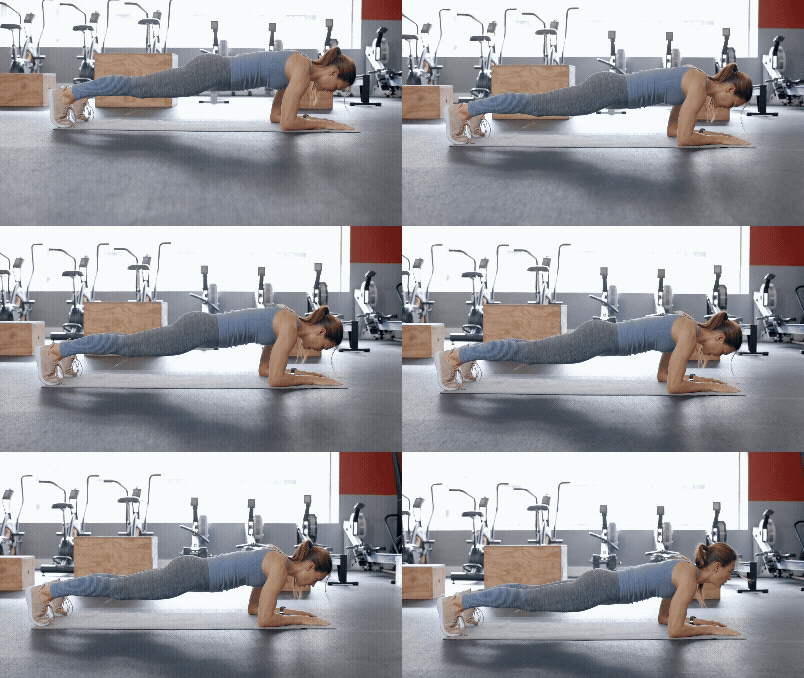
Isometric exercise means your muscle produces tension while its length stays the same. The joint doesn’t move. Think of a plank, a wall sit, or holding a weight steady at a fixed angle. You’re working hard, but nothing travels up or down.
Isometric work has real value. It’s often used in early rehab or when movement is painful, because it builds strength without requiring the joint to travel through a range of motion. The trade-off is that those gains tend to stay specific to that angle—holding a position well doesn’t translate cleanly into strength through a full range of motion. It’s a useful tool, not a complete strength program.
Isotonic: Constant Load Through Movement

Isotonic exercise is what most people picture when they think of strength training. You move a load through a range of motion: the weight goes up, the weight comes down. Squats, presses, rows, push-ups, free weights, and traditional weight-stack machines are all isotonic. “Isotonic” means “same tension”: the external load stays constant from your first rep to your last.
This is the backbone of conventional training. It mirrors real-world movement and has decades of research behind it. But there’s a built-in limitation, and it comes down to physics: gravity only pulls one direction, and the load never changes.
Your strength, on the other hand, isn’t constant. You’re stronger at some joint angles than others, and stronger when lowering a weight than lifting it. So with a fixed load, you end up under-challenged at your strong points and working near your limit at your weak ones. A hundred pounds is a hundred pounds whether you’re in a powerful position or a vulnerable one. That mismatch is the reason traditional training leans on multiple sets and longer sessions—it’s the workaround for a load that can’t meet you where you actually are.
Isokinetic: Constant Speed You Push Against

Isokinetic exercise holds something different: constant speed. The FastFit® machine doesn’t speed up when you push harder, and it doesn’t slow down when you fatigue. Your job is to produce as much force as you can against that steady movement, at every point in the range.
This part is easy to get wrong, so it’s worth being precise. The machine isn’t reacting to you or adjusting itself to match your effort. It’s doing one thing—maintaining constant speed. Because the speed never changes, you’re free to apply maximal force through the entire movement, from the first degree of motion to the last. There’s no easy part of the rep to coast through, and no momentum carrying the weight for you. The force is always yours.
For decades, isokinetic training lived almost entirely in sports-medicine labs and rehab clinics, where it’s been used to test and rebuild muscle with precise control over speed and effort. The equipment was large, expensive, and supervised by specialists. That’s why most people have never trained this way.
Why This Matters for Your Results
Mechanical tension is the primary driver of muscle growth and strength. The more tension you can produce across a full range of motion, the stronger the signal you send your muscles to adapt.
Isotonic training caps that tension at whatever your weakest point can safely handle. Isokinetic training removes the cap. Because the speed stays constant, you can produce maximum force at every joint angle—including the lengthened positions and the lowering phase, where much of the adaptation happens.
That’s the difference in practical terms. Not a different exercise—a different category of resistance, one that lets you put in maximum effort at every point in the movement, without a weight stack dictating the terms.
Isokinetic vs. Isotonic: Western Colorado University Study
This isn’t only theory. In a 12-week randomized controlled trial, researchers at Western Colorado University put the two categories head-to-head: isokinetic training (FastFit®) against isotonic training (traditional weights), with both groups starting from the same untrained baseline. The isokinetic group trained in roughly a third of the time per session—and still came out ahead in every category measured: strength, body composition, and cardiovascular fitness.
Outcome (12 Weeks)
Isokinetic (FastFit®)
Isotonic (Weights)
Body fat reduction
4.4%
1.7%
Cardio fitness (VO2max)
+5.2 units
+1.5 units
Chest press strength
+40.8 lbs
+17.9 lbs
Time per session
~15 min
~45 min
Same twelve weeks. Same effort to show up. The one variable that changed was the kind of resistance—the kind of tension—each group trained against.[1]
FastFit® Brings Isokinetic Training to a Studio Near You
Our machines run on isokinetic technology: constant speed, with you producing force against the movement. It’s the same principle long used to rebuild elite athletes in rehab situations—now in a 20-minute session with our certified personal trainers. You bring the effort. The machine keeps the speed steady so none of that effort goes to waste.
Curious what maximum tension actually feels like? Book a free, no-risk intro session at a studio near you.
Citations
- [1] Dalleck et al., 2021, International Journal of Research in Exercise Physiology.


